
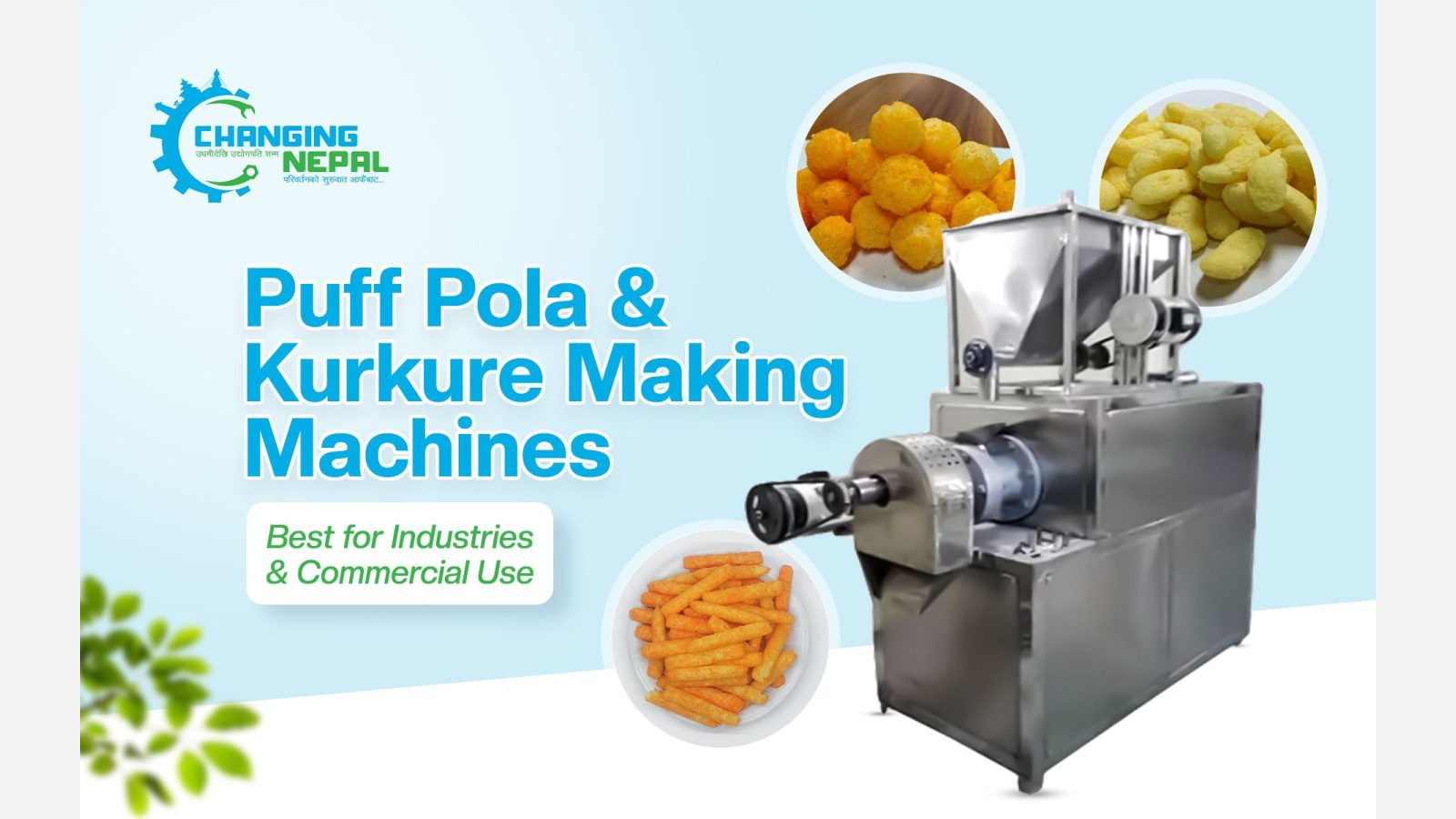
Nepal's food processing sector has witnessed immense growth in recent years, with the snack food segment taking the lead. As lifestyles evolve, urbanization gathers pace, and with the influence from the neighboring nation of India, puffed corn foods like Puff, Pola, and Kurkure are now household words, everywhere from the street vendor to the supermarket. At the heart of this phenomenon is a string of inventive gear carefully designed for the mass production of safe and consistent snack foods.
Puff-style snack foods like Kurkure, Pola, and corn puffs are thriving globally due to their crunchy delight, convenient portability, and bold taste. Industrially, they rely on extrusion technology—the equipment that transforms plain flour-based dough into complex, puffed, coiled shapes with heat, pressure, and mechanical shear. To companies that need to break even or build brands, the right machine matters in terms of efficiency, quality, and capacity.
This report does an extensive study of Puff Pola Kurkure manufacturing machines tailored to Nepal's industrial and commercial economy, detailing their technology, leading suppliers, market benefits, challenges, and long-term prospects.
Puff, Pola, and Kurkure
- Puff Snacks: Light, airy snacks manufactured by extruding and rapidly cooking starchy cereals, typically corn or rice.
- Pola: Similar to puffs, but typically made with other shapes and flavors, pola are extremely popular among rural and urban Nepalis.
- Kurkure: Crispy, curled-up snacks originally introduced by Indian brands but now predominantly produced locally by Nepali companies, sold in spicy, sour flavours which Nepali consumers prefer.
Snack Consumption Patterns in Nepal
- Growing demand from children and adolescents for easily consumable, affordable snacks.
- Availability of local and international snack brands in shops across Nepal.
- Greater demand for hygienically prepared, attractively packaged snacks is driven by increased awareness among consumers.
The Rise of Industrial Snack Production in Nepal
Traditionally, snacks were produced by small-scale enterprises. Automation and machine-based production now allow Nepali entrepreneurs to:
- Ensure consistency and food safety.
- Meet booming local and export market demand.
- Enjoy economies of scale.
Small and medium businesses, such as Century and other emerging snack companies, such as those operating in Janakpur, show how machines and industrial power are essential to business expansion and achieving product consistency.
Types of Puff Pola Kurkure Making Machines Available in Nepal
There is a variety of machines, ranging from semi-automatic to totally automatic lines, for enterprises of all sizes:
|
Machine Type |
Typical Output (kg/hr) |
Automation Level |
Application |
Price Range (NPR) |
|---|---|---|---|---|
|
25–50 |
Semi-automatic |
Small factories/start-ups |
120,000–150,000 |
|
|
Fully Automatic Plant |
80–200+ |
Fully automatic |
Medium to large producers |
300,000–1,500,000 |
|
Rotary Head Kurkure Line |
100–300+ |
Fully automatic |
Specialized Kurkure/snacks |
300,000–1,500,000 |
|
Multi-purpose Snack Machine |
30–200 |
Semi/fully automatic |
Puffs, rings, curls, etc. |
Important Features of Puff Pola & Kurkure Making Machines
1. Food Safety & Construction
- Food-grade stainless steel (sanitary) body for sanitation and easy cleaning.
- Closed systems minimize contamination.
2. Automation & Control
- Precision-controlled extruders and fryers.
- Programmable logic controllers (PLC) for accurate process parameters.
- Real-time monitoring of temperature, pressure, and feed ratio.
3. Efficient Production
- Continuous production capabilities, allowing 24/7 operation if needed.
- Rapid switching between snack types with modular dies and attachments.
4. Energy & Resource Management
- Efficient heating and frying systems to reduce energy bills.
- Smart use of raw material to minimize wastage.
5. Support for Innovation
- Flexible configuration allows diverse shapes, spices, and fillings to cater to Nepal’s evolving taste trends.
- Fast-change mechanisms to gear up for new products.
How Do Puff Pola Kurkure Making Machines Work?
- Raw Material Feeding: Corn/rice grits, flour, and water are fed in from the hopper.
- Mixing & Extruding: A screw conveyor mixes and compresses the ingredients under heat and pressure, blowing out the starches.
- Shaping & Cutting: The extruded mass is passed through special dies; for Kurkure, a rotary head twists the dough.
- Preparing (Roasting/Shallow Frying): Fragments are pre-cooked in hot oil in fryers or advanced air roasting machinery.
- Flavoring: Products move through a flavoring drum, which contains an even deposition of spice or cheese seasonings
- Cooling & Packaging: Products are moved through automatic conveyors, which cool them down before packaging for sale, ensuring they reach the consumer clean and fresh.
Top Snack Machine Suppliers & Price Snapshot
|
Supplier/Brand |
Machine Type |
Capacity |
Price (NPR) |
Notable Features |
|---|---|---|---|---|
|
Batch Mixer/Extruder |
25–50 kg/hr |
120,000–150,000 |
Local dealer, easy to operate |
|
|
Royal Machinery (India) |
Rotary Head Kurkure Line |
35+ kg/hr |
300,000+ |
Export quality, high capacity, warranty |
|
K.S. Engineering (India) |
Pola/Puff Machine |
125 kg/hr |
245,000+ |
Multi-purpose dies; installation assistance |
|
Misc. Indian Suppliers |
Automatic Lines |
100–250 kg/hr |
800,000–1,500,000 |
Fully automated lines, all-in-one solution |
Though the majority of machines are imported and assembled locally using Indian or Chinese components, Nepal-based manufacturers such as Changing Nepal are beginning to create customized solutions for the domestic market, in the technical capabilities of the nation.
General Machine Specifications (available in Nepal)
|
Feature |
Details (Example Machine) |
|---|---|
|
Material to be Extruded |
Corn, rice, etc. |
|
Capacity |
25–250 kg/hr |
|
Power Consumption |
5–27 kW |
|
Automation Level |
Semi/Full |
|
Construction |
Stainless steel |
|
Voltage/Phase |
Single/Three-phase |
|
Output Shapes |
Rings, balls, curls, sticks, twists |
|
Yes, with warranty |
|
|
After-sales Service |
Available from local dealers |
Why Invest in Puff Pola & Kurkure Machines in Nepal?
1. Improved Productivity
- Automatic, high-volume machines allow firms to complete bulk orders in an efficient way and serve both urban and rural markets.
2. Quality and Consistency
- Precision controls ensure that each batch is identical in taste, texture, and shape—factors crucial in building the brand as well as growth.
3. Cost Effectiveness
- Reduced manual intervention leads to lower recurring costs.
- Excess raw material usage is prevented with real-time monitoring.
- Wastage is minimized.
4. Food Safety Compliance
- Machines are constructed to global food standards of safety (ISO, HACCP), all the more necessary as Nepali regulation tightens.
5. Market Responsiveness
- The ability to swap products (puffs, Kurkure, balls) accommodates the changing palates of Nepal's multi-ethnic market.
Commercial Applications: Who's Using These Machines?
i) Large Snack Manufacturers
Nepali businesses like Century own market shelves, prized for quality, safety, and new flavors—all made possible by industrial-scale machines.
ii) Regional Startups
Janakpur and other urban centers have witnessed the introduction of small-scale snack plants with a capacity of 250 kg/hr, whose products are sold to hundreds of small shops in towns and villages.
iii) Entrepreneurs & Diversifiers
Small entrepreneurs purchase batch machines to start with local snack shops that can be expanded step by step depending on particular demand.
Problems Confronting Nepali Snack Manufacturers
- Import Dependence: There are still too many machines, especially automated machines, that have to be imported, and therefore, the cost is higher due to customs and transport.
- Technical Expertise: Operators require training in operating, maintaining, and fixing new machines, though most vendors these days include training and assistance.
- Regulatory Adherence: With evolving food safety regulations, makers must adapt equipment to Nepali and international standards.
- Competition: The sector is quickly evolving, so continuous innovation (flavors, forms, packaging) is critical.
- Limited parts & service: Nearby suppliers may not supply advanced spares, die-heads, or technical assistance.
- Economies of scale: Nearby small batches raise unit cost, reducing competitiveness.
Picking the Proper Machine for Your Business
Key Choice Factors:
- Capacity Needs: Choose based on your target market—local, regional, or national.
- Modularization: Select machines that can easily change product varieties.
- Automation: More automation means more rapid capacity expansion and less labor reliance, but it does have higher initial costs.
- Local Supplier support: Find local suppliers, especially for short-term, immediate supply and service of parts.
- Cost Negotiation: Very Price sensitive for suppliers, where initial cost can be a guarantee of long-term return on investment.
Step-by-Step: Setting up a Puff Pola Kurkure Factory in Nepal
- Market studies: Find where you will sell your product (local shops, export, supermarkets).
- Location and Utilities: Use available space, have a reliable electric and water supply.
- Machine selection: Choose based on capacity needed, ability to easily change the product offering, and support after the sale.
- Installation/Training: Have the installation with your supplier/engineer and train workers.
- Raw Materials: Develop contacts with grain/flour suppliers.
- Testing Batch and Quality Control: Create a stream of pilot batches for stabilising recipes and quality control.
- Packaging Brand: A good investment is to ensure your packaged product looks fresh and enticing on the shelf.
- Distribution: Either through wholesale and retail chains or direct to the consumer.
Real Life Example: Snack manufacturing in Janakpur
There is a small snack plant in Janakpur with eight people that produces 250 kgs/hour. The company delivers to about 400 retailers.
This business has relied on some domestic machinery and some imported machinery to grow sales very quickly on the basis of consistent and fast production from machine-based production.
Most of the newer equipment has allowed for a quick scale-up and has allowed for brand construction.
Tips to Maximize ROI
Here are some strategies to maximise Return on Investment:
- Maximize the batch sizes -- Create full capacity shifts to maximise the fixed costs.
- Create unique tastes – Use Nepali chilies, buckwheat, and millet to appeal to a higher aesthetic consumer.
- Establish secure sales channels – Start locally, partner with local stores, stalls, or websites to sell your products.
- Reinvest profits into capital – Move up to acquiring twin-screw extruders, continuous fryers, and automatic packaging.
- Focus on quality and space – "Made in Nepal" with Nepali flavor and small-business identity should be good enough for your consumers.
The Future of Snack Processing in Nepal
The market for snacking in Nepal will undoubtedly continue to grow, especially with the factors of urbanization, changing diets, and the desire for safe, cheap, and tasty snacking. There is an endless number of machine manufacturers looking to design innovations that:
- Implement combined IoT-based monitoring with digital controls to create further improved efficiencies
- Support energy-efficient, environmentally-friendly baking and frying
- Allow for even more customization of products, including both Nepali and export markets
Conclusion
The Puff Pola Kurkure production machines are a vital backbone to the revolution taking place in Nepal for snack-making by bringing repeatable quality, scalable capacity, and also allowing for product diversification. Whether you're a mass producer or a hopeful dreamer and entrepreneur, if you're patient and willing to invest a modest outlay to acquire the right machine and the skills to eventually operate it, you can transform your future within the exciting, rapidly growing Nepalese snack market.
Your business can benefit from the best Puff Pola Kurkure production solutions, as well as be a part of Nepal's success story in safe, tasty, and creative snacks!
Ready to take the next step?
Look no further than Changing Nepal Machinery! Changing Nepal Machinery is a locally based and trusted food processing machinery provider in Nepal that has great local support, modern technology, and affordable rates.
Here is what Changing Nepal Machinery offers:
- Batch mixers and extruders for Nepali start-ups.
- Dependable after-sales support and spare parts.
- Tailored options for different capacities and snack types.
- Support with installation and training for your operators.
Whether you are starting your first snack plant or upgrading to a modern high-capacity line, Changing Nepal Machinery is your complete solution.
Frequently Asked Questions
Q: Can the machines create different shapes and flavours?
A: Yes, most machines have interchangeable dies and reversible flavour systems to serve various Nepali tastes.
Q: How difficult is it going to be to service these machines in Nepal?
A: Most suppliers provide local training, useful manuals, and spare parts, which reduces downtime when servicing the machines.
Q: Are there any energy issues with running these types of machines?
A: Machines are generally built efficiently now; obtain machines that meet the local electrical standards, so that this does not become an issue.
Q: How long will they last?
A: Properly maintained food-grade machines can last 10 to 20 years or more.
Q: Can the machines be used at home?
A: Well, business purposes would be best accommodated by the industrial-scale machines, but small semi-automatic machines can be used in small local snack businesses.