
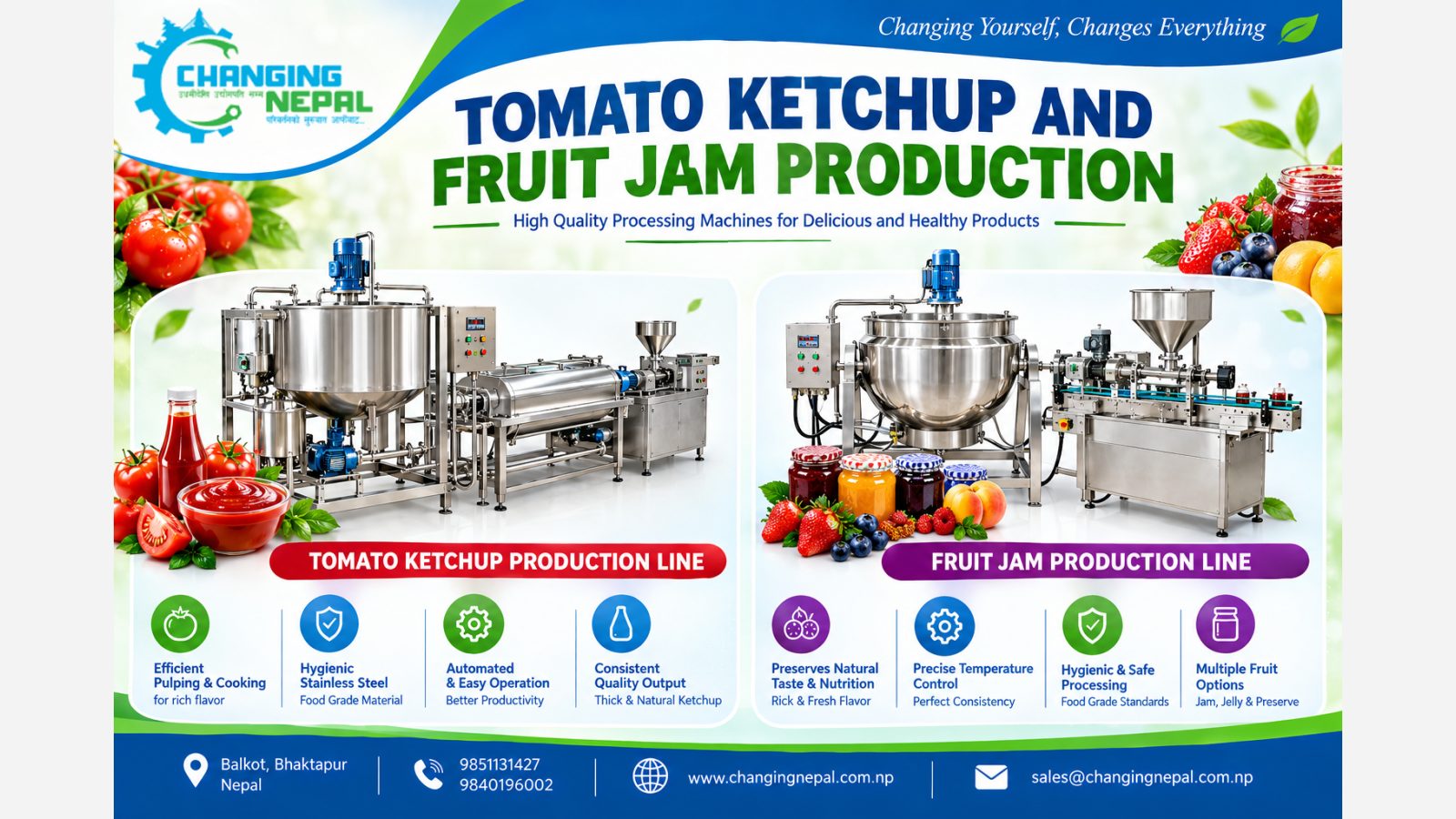
Tomato ketchup and fruit jam machines are the equipment used to process fresh tomatoes and fruits into ketchup and jam. They are mainly responsible for pulping and cooking. Though ketchup and jam are different products involving different ingredients and preparation techniques, they share the process of cooking and pulping. Thus, the tomato ketchup production machines, namely the pulper and the kettle with agitator, can also be used for fruit jam production.
Traditionally, ketchup and jam were made in open pots with manual stirring and uneven heating. A modern electric jacketed kettle with agitator replaces this with controlled, even heating through a water/oil jacket and automatic mixing. This way, the resulting ketchup or jam gets an even texture and taste, improving the quality of the produce.
In the context of Nepal, tomato ranks third in area and production and first in productivity among vegetables grown in the country. Similarly, fruits like mango and banana and hill-grown citrus are abundant in the summer season. This enables ketchup and jam production facilities in Nepal to source raw materials locally and reliably. Both products have a shelf life of up to six months; thus, ketchup and jam production also lets farmers and small processors turn surplus produce into a profitable product.
The business of ketchup and jam production is highly flexible. New entrepreneurs can start on a small scale, with small space, skills and manpower. Established businesses can also boost their production capacity with high-capacity automatic machines. This article dives deep into the ketchup and jam production process and the machines available for it.
Section Links
Production Process
Tomato Ketchup Manufacturing Process
- Selection and Washing: Ripe, fresh tomatoes are selected and washed.
- Crushing and Pulp Extraction: Washed tomatoes are crushed and their pulp is extracted using the Tomato Pulper Machine.
- Cooking and Concentrating: In a Jacketed Kettle with Agitator, the pulp is mixed with ingredients like sugar, salt, vinegar and spices and heated to reduce water content.
- Cooling and Quality Testing: The cooked ketchup is cooled and checked for pH, taste, and microbial safety.
- Filling and Sealing: The prepared ketchup is filled into sterilised bottles or pouches, sealed and dispached for sale.
Fruit Jam Manufacturing Process
- Raw Fruit Inspection: Ripe, disease-free fruit is selected by colour, ripeness, odour, and quality.
- Washing: Fruit is washed with chlorinated water.
- Pulping and Seed Extraction: The Pulper Machine removes seeds, core, and fibrous material to produce fruit pulp.
- Addition of Sugar and Pectin: The extracted pulp is mixed with ingredients like sugar, water, and pectin in the Jacketed Kettle.
- Boiling and Concentration: The mixture is boiled and stirred automatically in the Jacketed Kettle with Agitator.
- Citric Acid Addition: Citric acid is added to adjust pH and promote jelling.
- Hot Filling and Sterilisation: The jam is filled into sterilised, capped bottles and dispatched for sale.
Machines Available in Nepal
Tomato Pulper Machine
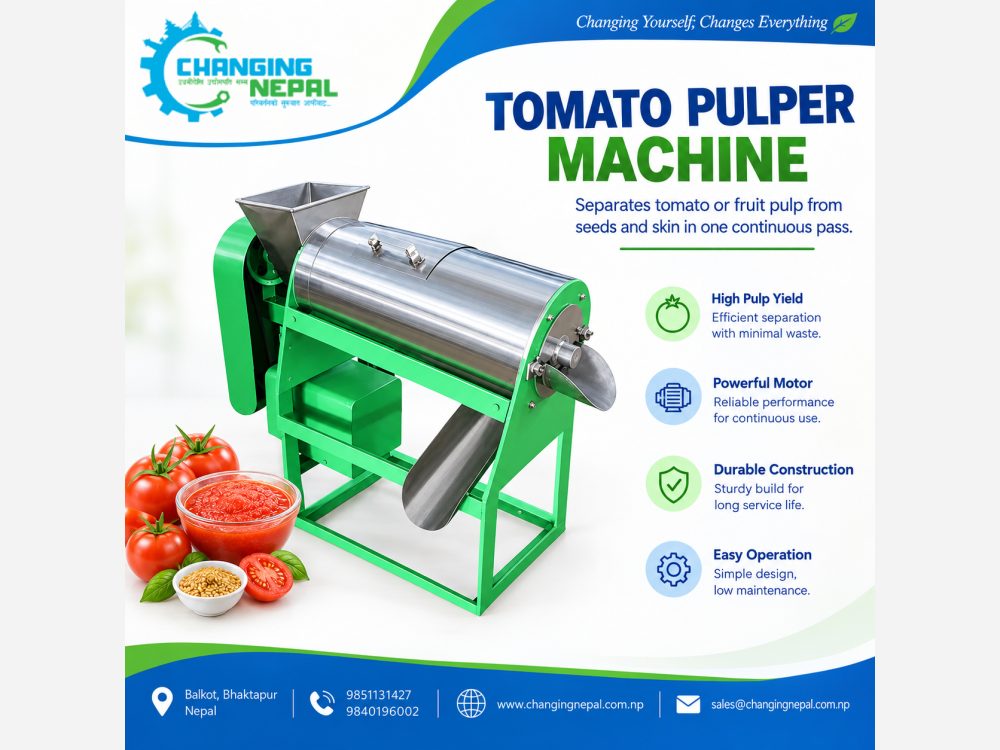
The Tomato Pulper Machine is the first step in both ketchup and jam production. It separates tomato or fruit pulp from seeds and skin in one continuous pass. It is suitable for small to medium processors.
| Model | Motor | Price (NPR) |
|---|---|---|
| 16 inch Pulper | 1 HP | 49,000 |
| 20 inch Pulper | 1.5 HP | 59,000 |
Jacketed Kettle with Agitator
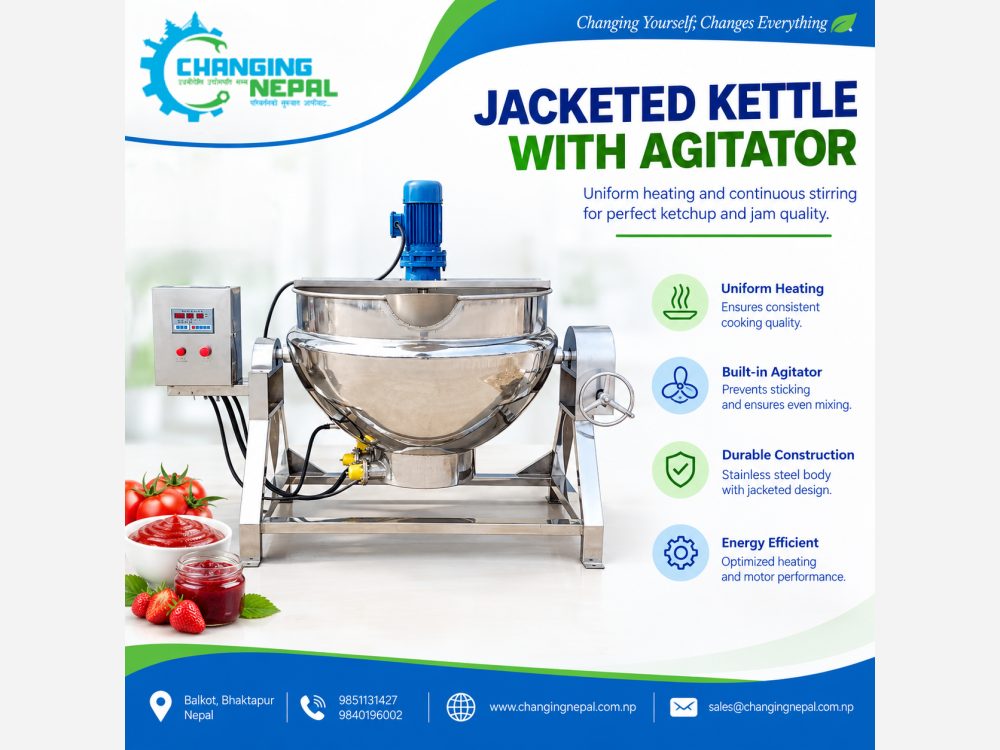
The Jacketed Kettle with Agitator is the core cooking machine for both ketchup and jam. It is a multi-layer pot with a built-in mixing paddle that automatially boils the pulp and spice mixture while stirring continuously. It applies uniform heat ensuring optimum quality.
| Model | Type | Heating Power | Motor Power | Price (NPR) |
|---|---|---|---|---|
| 100L Kettle | Electric heating | 18 kW (2 x 9 kW) | 1.1 kW | 320,000 |
| 100L Kettle | Gas with insulation | – | – | 330,000 |
| 200L Kettle | Electric heating | 18 kW (2 x 9 kW) | 1.1 kW | 380,000 |
| 200L Kettle | Gas with insulation | – | – | 380,000 |
| 300L Kettle | Electric heat-assisted | 24 kW (2 x 12 kW) | 1.5 kW | 440,000 |
| 300L Kettle | Gas with insulation | – | – | 440,000 |
Comparison Table
| Machine | Model | Type / Motor | Capacity | Price (NPR) |
|---|---|---|---|---|
| Tomato Pulper Machine | 16 inch | 1 HP motor | – | 49,000 |
| Tomato Pulper Machine | 20 inch | 1.5 HP motor | – | 59,000 |
| Jacketed Kettle with Agitator | 100L | Electric, 1.1 kW motor | 100L | 320,000 |
| Jacketed Kettle with Agitator | 100L | Gas with insulation | 100L | 330,000 |
| Jacketed Kettle with Agitator | 200L | Electric, 1.1 kW motor | 170L effective | 380,000 |
| Jacketed Kettle with Agitator | 200L | Gas with insulation | 170L effective | 380,000 |
| Jacketed Kettle with Agitator | 300L | Electric, 1.5 kW motor | 250L working volume | 440,000 |
| Jacketed Kettle with Agitator | 300L | Gas with insulation | 250L working volume | 440,000 |
Frequently Asked Questions
1. What is a jacketed kettle used for in ketchup and jam making?
A Jacketed Kettle with Agitator is used to cook, concentrate, and continuously mix tomato pulp or fruit pulp with sugar, salt, and other ingredients until it reaches the right thickness for ketchup or jam.
2. Is an electric jacketed kettle better than cooking on an open fire?
Yes, the jacketed design heats evenly through the casing instead of direct flame. The batch does not scorch, mixing is automatic, and cooking time and fuel use are both reduced.
3. How much investment is needed to start a ketchup or jam business?
A small starter setup with a Tomato Pulper Machine and a 100L Jacketed Kettle can be started from around NPR 3.7 lakh, while larger 300L kettles suit bigger production volumes.
4. What raw materials are needed for ketchup and jam production?
Ketchup mainly needs tomatoes, sugar, salt, vinegar, and spices, while jam needs fruit, sugar, pectin, and citric acid. They are grown and available locally in Nepal.
5. Should I choose the electric or gas version of the jacketed kettle?
The electric version suits areas with reliable power supply and gives more precise heat control. The gas-with-insulation version is useful where electricity is limited or where gas is the cheaper fuel option locally.
6. Is ketchup and jam making a good small business idea in Nepal?
Yes, both products use locally grown raw material and have a shelf life of up to six months. The business can be started at small or large scale, and meet steady household and food-service demand.
7. How much space and manpower is required to run these machines?
A small unit with a pulper and a 100L-200L kettle can run in a modest processing room with 2-3 workers, while larger 300L setups need more floor space and additional staff for washing, filling, and packing.