
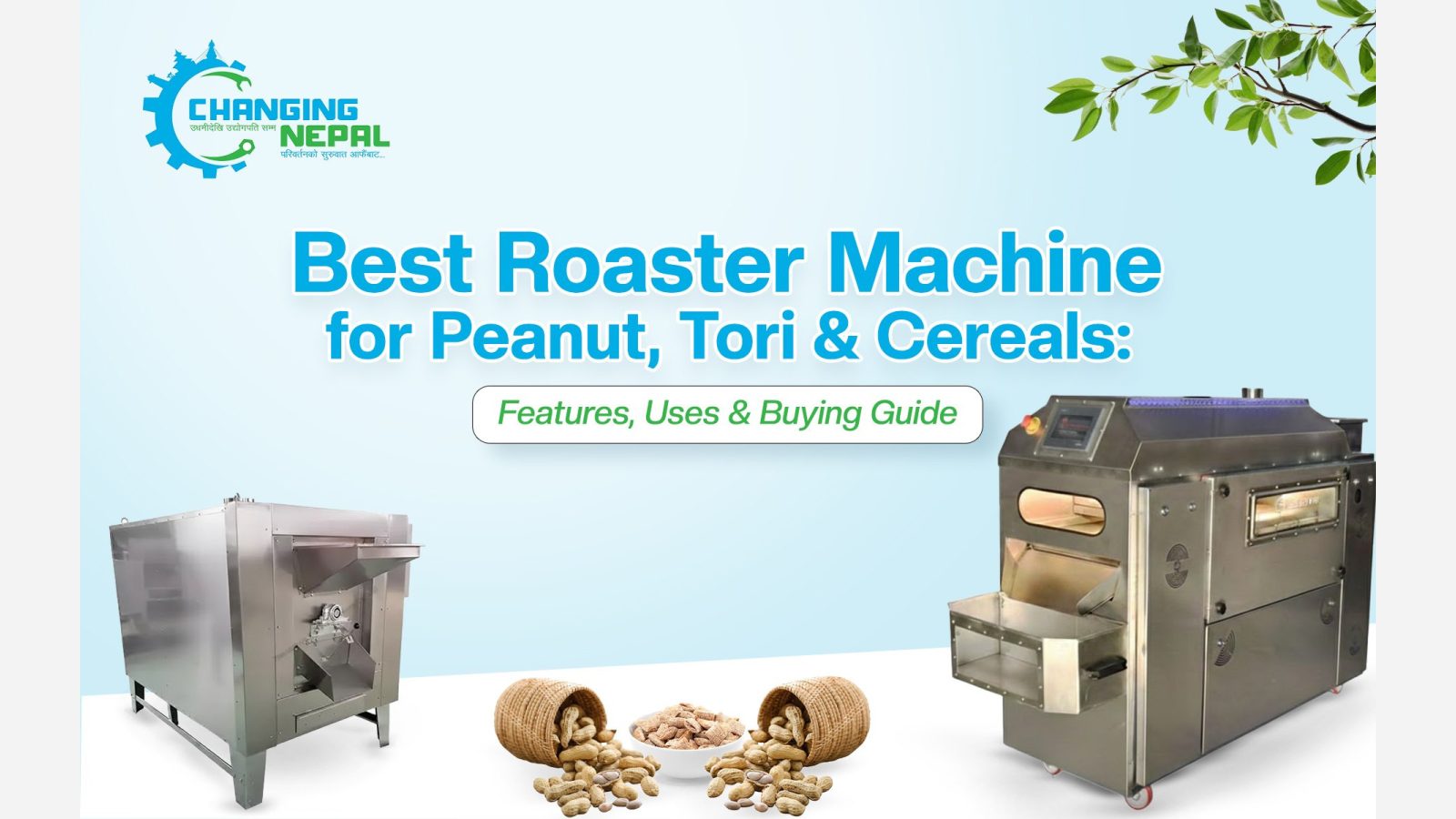
Roaster machines are becoming increasingly essential in modern food processing, such as peanuts, mustard seeds (tori), cereal grains, spices, and pulses. The quality, consistency, energy efficiency, and profitability of any commercial snack manufacturer and agro-industry depend on the right machine roaster.
Taking away from traditional practices of roasting using iron pans, sand, and open roasting, food-processing industries are now shifting towards machine roasting to achieve a modernized, more sophisticated approach with uniform heating, faster production cycles, temperature control, automation, and easy maintenance.
In this article, you will find all the information you need to select a good roasting machine for peanuts, tori, cereals, spices, and multi-grain applications.
What is a Roaster Machine?
A roaster machine is an industrial device that uniformly heats, dries, and roasts food items under controlled thermal energy. It uses:
- Electric heating coils
- Gas burners
- Infrared heating technology
- Hot air convection systems
In this way, the machine moves or agitates the food material for:
- Even heat exposure
- Zero burning
- Consistent color
- Enhanced aroma and flavour
Roaster machines can also be used for:
- Peanut roasters
- Spice and oilseed processing plant
- Grain and cereal processing
- Agro-food manufacturing
Why Choose a Roaster Machine Nowadays
The tantalizing smell of freshly roasted peanuts, tori seeds, and cereals will draw customers to your stall or kitchen. A dedicated roaster machine ensures that raw materials are uniformly roasted, preserving nutrients and enhancing flavours in snacks, peanut butter, or traditional Nepali mixes. Machines from suppliers like Changing Nepal are gradually becoming efficient for Nepali home users and vendors in Nepal’s booming snack market.
Roasting involves a loss of 5-10% moisture, which brings out oils that significantly improve the taste and texture of tori or cereals, as in chiura. Heavy sales are anticipated around Dashain and Tihar, so that this investment will pay off- it will retain 80% of the workers and smoothly manage production.
Types of Roaster Machine for Every Need
Modern roasters come in multiple variants tailored to distinct applications.
1. Drum Roasters: Full of Flavour
With simultaneous conduction and convection, drum roasters rotate peanuts or tori in a heated cylinder, achieving rich, caramelized results at temperatures ranging from 120 to about 180 °C. They are ideal for small batches of cereals and prevent scorching by constantly moving.
Changing Nepal offers gas-powered drum models, perfect for Nepali businesses, with load capacities ranging from 20 to 100kg and durable stainless steel construction.
Best for: Peanuts, mustard seeds, rice, corn, pulses
Key Features:
- The rotating drum ensures uniform roasting
- Fast heating and efficient heat retention
- Gas or electric-powered
- Capacity: 10 kg to 200 kg
Best in the market due to reliability, low maintenance, and use in: Drum roasters.
2. Tray-Type Roaster
Small to medium batch sizes of cereals or sensitive oilseeds are ideal for use with tray-type roasters, as the trays allow independent temperature control per tray to customize roasting profiles, as well as preventing overcooking fragile items such as tori.
The peanuts, tori, spices, herbs, or grains are spread out evenly across multiple perforated trays in this convection oven-style chamber, which uses gentle, hot air circulation at 80-150°C to achieve nutrient-preserving results.
Changing Nepal offers electric tray models perfect for Nepali homes and small businesses, capable of handling loads of 10-50kg with durable stainless steel trays for easy loading and hygiene.
Best for: Spices, herbs, grains
Advantages:
- Multiple trays
- Independent temperature control
- Ideal for low-heat roasting
3. Continuous Conveyor Roasters (For Industrial Scale)
With hot air circulation at 50-300°C, continuous conveyor roasters carry peanuts, tori, or cereals over multi-layer belts through long heating zones, producing a uniform mass production of 500-2000 kg/h using fully automated feed systems and precise PLC controls.
Best suited for very high-volume factories dealing with oilseeds or grains, these highly automated machines are designed to reduce labor by integrating cooling in the system and limiting product breakage below 5% due to gentle agitation.
Changing Nepal also supplies gas/electric conveyor models to the Nepali industrial clientele, catering to large loads and seamless, round-the-clock running.
Guaranteed benefits: Best for very high-volume factories
Features:
- Continuous feeding system
- perfect for mass production
- Completely automated
4. Hot-Air Fluidized Roaster
Hot-air fluidised roasters roast peanuts, tori, cereals, or high-end spices in a film of circulating hot air (80-250 degrees) without active contact with the hot element and scalding temperatures, using high-powered blowers to produce a fluidised bed.
Ideal for premium products with gentle roasting, such as delicate tori seeds or high-end cereals, they offer instantaneous airflow adjustments and short cycle periods (10-20 minutes) with 2% defect or less.
Changing Nepal caters to the electric fluidised models, which are ideal for Nepali premium processors, featuring a carry capacity of 20-80kg with stainless steel chambers that guarantee hygienic and consistent results.
Best for: Premium products that require gentler roasting.
5. Infrared Roasters: the Potent Energy Saver
The infrared roasters use penetrating waves (1-5μm) for fast roastings of 150-250°C over 8-15 minutes on peanuts, tori, or heat-sensitive seeds while minimizing nutrient losses (<5%), as well as saving 40-60% energy. It is ideal for uniform crispness on delicate cereals, increasing the oil yields by 10-15%.
Changing Nepal offers electric models for 10-60kg Nepali batches with SS emitters.
Advantages:
- Faster roasting
- Minimal nutrient loss
- Best suited for heat-sensitive seeds
Features of The Best Roaster Machine For Peanut, Tori, and Cereals
1. Maintenance Ease
A high-quality roaster should have:
- The removable drum or trays
- Easy lubrication points
- Rust-proof stainless steel body
- Waste and husk collection system
Low maintenance means longer machine life and lower downtime.
2. Size & Roasting Capacity
Capacities available:
- Small: 5-10 kgs per batch
- Medium: 20-30 kg
- Large Industrial: 50-200 kg+
Choose according to:
- Daily production requirement
- Power source availability
- Growth plans
3. Multi-Material Compatibility
Good roasters should accommodate:
- Peanut
- Mustard (tori)
- Wheat, rice, corn, millet
- Chickpea, soybeans
- Cashew-almond types:
- Spice
4. Temperature Control Specificity
Different food roasts at different temperatures:
- Peanut: 160-180 degrees Celsius
- Mustard (tori): 140-160 degrees Celsius
- Cereal: 120-150 degrees Celsius
- Spices: 80-120 degrees Celsius
A precise thermostat prevents burning and bitterness.
5. Effective Operational Efficiency
Indicators of quality machines include:
- Low loss of heat
- Shorter cycles of roasting
- Energy-efficient design
- Automatic shut-off
6. Safety Features
Safety at industrial levels is also important. These must-have features:
- Heat-resistant handles
- The SS body that is food-grade
- Overload protection
- Anti-skid Base
- Shockproof wiring
Uses of Roaster Machines(Peanuts, Tori, & More)
1. Peanuts
Uses include:
- Roasting peanuts
- Masala peanuts
- Peanut-based snacks
- Peanut butter production
Roasting benefits are as follows:
- Crunchiness
- Flavor activation
- Shelf stability
2. Mustard Seeds (Tori)
Mustard seeds are heat-sensitive and subjected to controlled roasting.
Applications:
- Achar (pickles)
- Oil extraction
- Spice powder blends
- Seasonal food manufacturing
Proper roasting enhances aroma and removes raw bitterness.
3. Spices
Roasting spices enhances:
- Aroma
- Essential oil release
- Texture
Suitable for:
- Cumin
- Coriander
- Fenugreek
- Fennel
- Mustard
- Mixed spices
4. Cereals & Grains Roasters are available for:
- Rice
- Corn
- Wheat
- Barley
- Oats
- Millet
Commonly used in cereal mixes, snacks, and breakfast products.
5. Smell & Texture Improvement
Uniform roasting guarantees:
- Better mouthfeel
- Balanced color
- Improved crunch
- Premium aroma
Best Buying Guide: How to Choose the Best Roaster Machine
Match scale, seed type (peanuts, tori, cereals), fuel, and budget with capacity, temperature control, efficiency, and easy-clean features for uniform roasts and max profits in obtaining the perfect roaster.
1. Identify Your Primary Roasting Need
Ask:
- Will I mainly roast peanuts?
- Do I need multiple-material capabilities?
- Should the machine accommodate spices and cereals?
This determines the type of roaster for you.
2. Choose the Right Capacity
Match machine size to:
- Daily/hourly output
- Availability of staff
- Power backup
- Area of production
3. Heating Method: Electric vs Gas
Electric Roasters
- Best for indoor use
- Provides consistent heat
- Produces low emissions
Gas Roasters
- Operating costs are lower
- Ideal for bulk roasting
- It heats up faster
4. Inspect Build Quality
Prefer:
- 304 stainless steel
- Heat-resistant coating
- Solid metal gears
- High-quality bearings
5. Check Energy Consumption
A good amount of the machine should save:
- 20-40% energy
- Reducing the operational cost
- Speeding up the roasting process
6. Easy Cleaning System
Food-grade hygiene needs:
- Smooth internal surfaces
- Removable trays/drum
- No sharp inner edges
7. After Sales Support & Warranty
Choose a brand that offers:
- Spare parts availability
- At least 1-year warranty
- Accessible service centres
Conclusion
Roaster machines are an excellent choice in terms of elevating product quality instantly, irrespective of processing peanuts, mustard seeds (tori), cereals, or spices. With energy-efficient modern machines providing precision temperature control alongside uniform roasting, productivity can be increased while reducing operational costs.
Changing Nepal is a trusted name, offering reliable and high-performance roasting machines in Nepal for both small and large processors. If you are set to upgrade production and achieve consistent, premium results, Changing Nepal is the way to start.
Frequent Questions(FAQs)
1. Which is the best roaster machine for roasting peanuts and mustard seeds (tori)?
The best roaster machine depends on the level of production. Drum roasters are great for high-capacity roasting of peanuts and tori, while tray-type roasters are best for low-heat ingredients and spices.
2. How much does the commercial peanut or cereal roaster machine cost in Nepal?
The price depends on size and fuel type, but most commercial roasters in Nepal go from NPR 35,000 to NPR 250,000+, depending on the production capacity and material used, as well as automation. You can check updated prices at Changing Nepal.