
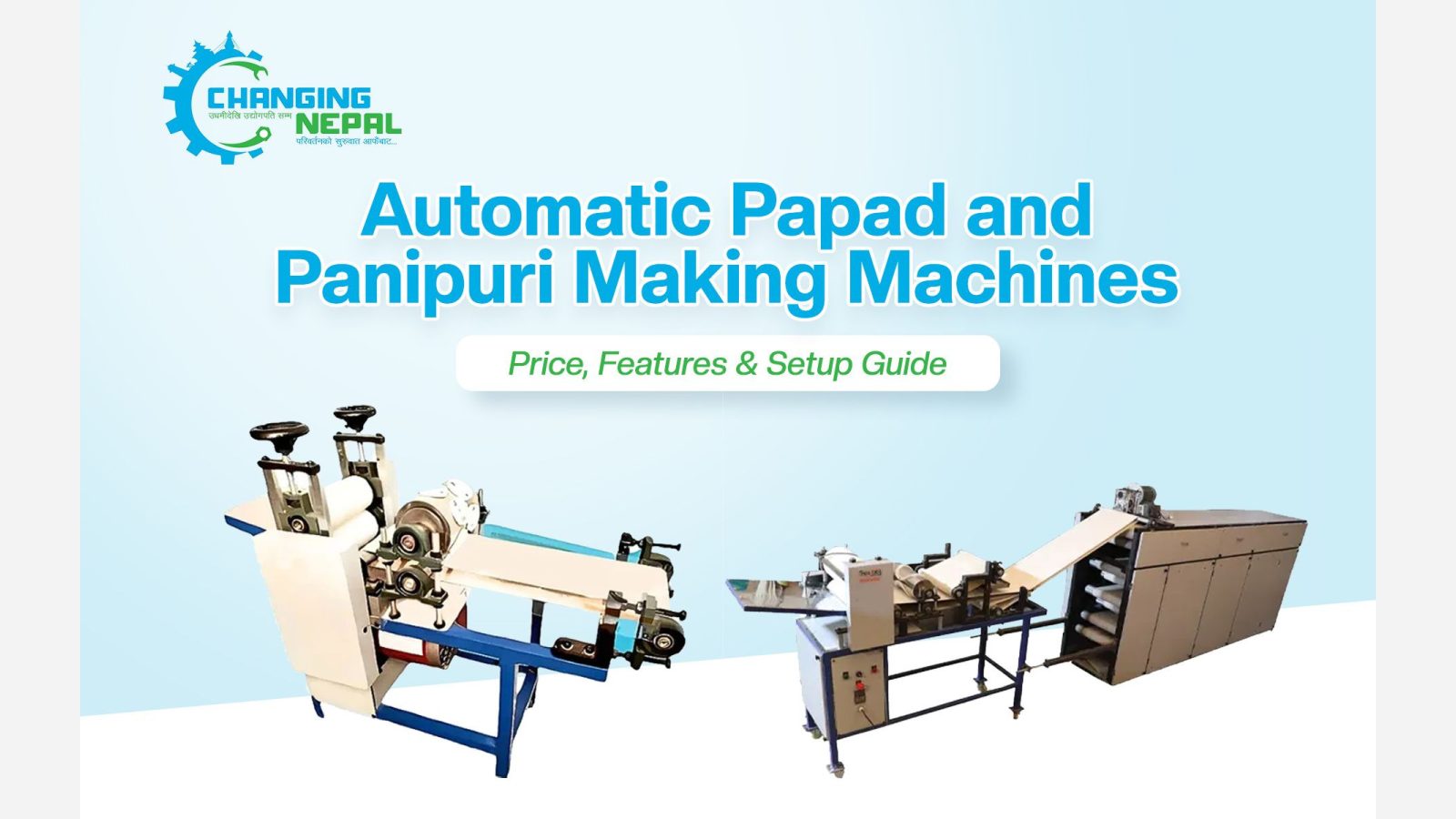
Papad and Panipuri happen to be among the most popular snacks in Nepal that are consumed all over the country for their distinct crunch and unique flavor. Traditionally, papad and panipuri are made by hand, but producing them in larger volumes takes a lot of time and effort. Fortunately, advancements in technology and automation allow for inexpensive, quality-focused automatic papad and panipuri making machines that remove the need for labor and greatly improve the production scale while also increasing hygiene and consistency of product.
This guide aims to provide you with the full range of current machines available to you in Nepal, including price, features, and advice on setup to help you determine which machinery would best meet your food business needs.
Papad and Panipuri Making Machines: Features & Prices in Nepal
Below is a summary of our currently available machines along with specifications, prices (in NPR), and features.
|
S.No |
Equipment Description |
Capacity |
Motor |
Features |
Price (NPR) |
|---|---|---|---|---|---|
|
1 |
Panipuri 3000 pcs/hr & Papad 800 pcs/hr machine |
Panipuri: 3000 pcs/hr Papad: 800 pcs/hr |
0.5 HP motor |
1 set die included, roller length 260 mm, roller diameter 140 mm, DC controller system available |
NPR 160,000 NPR 200,000 (with DC controller) |
|
2 |
Panipuri 3000 pcs/hr & Papad 800 pcs/hr machine with waste collector |
Panipuri: 3000 pcs/hr Papad: 800 pcs/hr |
0.5 HP motor |
1 set die included, roller length 260 mm, roller diameter 140 mm, waste collector attached, DC controller system available |
NPR 180,000 NPR 240,000 (with DC controller) |
|
3 |
Automatic Papad Making Machine with Continuous Dryer (3-layer, 10-inch width) |
Industrial scale |
DC motor |
Includes control panel, continuous 3-layer dryer, suitable for high volume large-scale production |
NPR 470,000 |
|
4 |
Automatic Papad Making Machine with Continuous Dryer (5-layer, 12-inch width) |
Industrial scale |
DC motor |
Includes a control panel, a continuous 5-layer dryer for higher capacity and faster drying |
NPR 550,000 |
|
5 |
Manual Papad Making Machine |
50-60 kg papad per day |
0.5 HP, 1440 rpm |
Compact size (27” x 18” x 30”), 63 kg weight, makes papad, panipuri puris, nimki, samosa, different shapes of roti, and snacks |
NPR 50,000 (Extra dies: NPR 10,000-15,000; dies with roller: NPR 40,000) |
Details & Benefits of Each Model
1 & 2. Panipuri & Papad Making Machines (3000 Panipuri/800 Papad pcs/hr)
These semi-automatic machines are recommended for a small to medium-sized food business or catering business. The only major difference between models 1 and 2 is that model 2 is equipped with a waste collector, which enables a cleaner working environment by removing waste dough or wasted papad dough, allowing for a cleaner work area. Both machines have a .5 HP motor with rollers that have a diameter of 140 mm and a length of 260 mm, allowing for uniform shaping and size. There are optional DC controller systems that can provide better, smoother control for speed and quality.
Price range: NPR 160,000 to NPR 240,000, depending on available features (with/without waste collector and controller).
3 & 4. Fully Automatic Papad Machines with Continuous Dryer
These machines are well suited to industrial manufacture of papad manufacturing units with multi-layer continuous dryers (3-layer and 5-layer options). The ability for high mass production for the sake of drying functionality is integral for a high-quality product and shelf-living production. Both machines contain DC motor control systems and user-friendly control panels that allow for automated preparation of papad.
Advantages:
- High mass production capacity.
- Ideal controls for consistent quality.
- Reduced drying times with the use of multi-layer convection dryers.
- Greater automation reduces reliance on skilled labor.
Price range: NPR 470,000 to NPR 550,000, depending on dryer capacity.
5. Manual Papad Machine
If you're doing small numbers or the old-fashioned way and want to increase production, this is a very durable and affordable choice. The machine has a 0.5 HP motor that can produce up to 50–60 kg of papad per day. This machine can also produce many different shapes - papad, panipuri puris, nimki, samosa wrappers, and various flatbreads.
Customization:
Additional dies are available for various shapes or types of roller at additional cost (dies: NPR 10,000-15,000, dies with roller: NPR 40,000).
Price: NPR 50,000 for a basic setup.
Selecting the Right Equipment for Your Nepali Business
When considering your machinery options, you should consider:
- Production Volume Goals: Manual/panipuri/papad combo will work for small shops, an automatic papad machine with a continuous dryer is more suitable for industrial units.
- Budget: By beginning with manual machines in a smaller shop, you have minimized your startup costs, while a full automatic unit is capital-intensive but offers more returns and productivity.
- Labour: Automatic machines reduce your reliance on staff.
- Space and Power: Make sure you can accommodate the floor space and that you have three-phase power where applicable for larger units.
- Product Variety: If you want flexibility (i.e., making panipuri puris in addition to papad, nimki, and samosa sheets), you should look for a machine where you could purchase dies that are compatible with various products.
Guidelines for Starting a Papad and Panipuri Business in Nepal
Step 1: Market Research
Identify the local demand for your product(s) in the market, hotels, restaurants, and events. Then you need to decide if you will be wholesale, retail, or both.
Step 2: Registration and licences
You must register your business and obtain a food safety and municipal licence. A hygiene standards investigation illustrates the importance of maintaining hygiene standards.
Step 3: Space and Utilities
Consider a 300-500 sq. ft. space with ventilation, water, and a stable electrical supply (triple phase is best for consistent dryer electrical requirements).
Step 4: Buying the Materials
Only buy quality pulses/flours/spices. It is essential to find reliable suppliers to ensure a consistent supply of your materials for continual production.
Step 5: Buying the Machine
Your supplier will recommend a machine based on the information outlined above. It is best to understand the support/services the supplier will provide after the sale, and to work out training for you or your staff.
Step 6: Hiring and Training Staff
If you have a trained operator who can run, service, and clean machines, then most of your problems will be identified early and or eliminated. You also need to train staff in food hygiene and safety.
Step 7: Managing Production
Always follow a standardised recipe, maintain your machine, clean your machine, and consistently check the quality of output from your machine.
Step 8: Marketing and Distribution
You should brand your products professionally (again, good quality production) and market them to local retailers, supermarkets, and e-platforms. If you have brand new ideas for packaging, this may pay dividends to your standing in the market.
Business Opportunities and Potentials for the Production of Marginal Business Products in Nepal
Production of processed papad and panipuri by automation has quickly gained an advantage over manual production systems because of:
- Overall, increasing urban demand for packaged snacks or food items (this trend is driven mainly by a demand for hygienic items).
- Opportunities are available in consumer demand, catering, and wholesale markets.
- Changing consumer preferences toward standardized products.
- The Government has been developing many initiatives that support small-scale food processing industries.
With initial investments starting as low as NPR 50,000 for manual machines and scaling upwards, new startups & entrepreneurs can build a profitable and scalable business in Nepal.
Tips for Success:
- Focus on quality and hygiene. Customers appreciate clean, well-packaged products.
- Use innovative recipes—think multi-lentil papads or flavored puris.
- Brand and packaging attractively; eye-catching packaging can boost retail sales.
- Record-keeping and cost control for sustainable profitability.
Conclusion
There is an explosion of street food markets in Nepal, combined with increased consumer obsessions around hygiene and safety. Hence is an amazing environment to have introduced the concept of automatic supplied papad and panipuri making machines. Regardless of the size you plan to start your business, whether a small start-up or large manufacturing unit, choosing a machine (as outlined in the previous sections for each of the machine models, capacities, and price estimates of the types of machines will complement your venture.
The purchased machines will need to provide the features you require. Along with proper business planning in all areas of both operational and revenue plans, staff training and development, and marketing, you will only help position your share of Nepal's common snack market further.
In addition, operational costs of the labour function will not just be reduced and adjustable; you will also ensure product quality, promote hygiene, and allow for scaling marketing to the same level, making for an exciting adventure in Nepal. Whatever the quantity of automation you decide to pursue, this will ensure you a successful venture, and if you remain innovative, you are likely to have your operational/functional ability promoted.
Don’t wait to modernize your snack production—invest in the right papad and panipuri making machine today! Whether you're just starting or scaling up, we have machines to suit every budget and business size. Contact Changing Nepal for expert guidance, machine recommendations, and exclusive pricing offers. Let’s build your profitable food venture in Nepal together!
Frequently Asked Questions (FAQs)
1. What are the differences between a semi-automatic and a fully automatic papad or panipuri machine?
Semi-automatic machines will require someone to manually labor for some steps of the process - such as dough feeding, shaping, frying, and the automation may be limited only to speed control, or waste collection. Fully automatic machines will automatically do most of the steps successfully, including dough preparation, pressing, shaping, drying (papad), frying, filling (panipuri), and packaging, with little human intervention, allowing for a lot more product to be made, consistent in quality, and with lower labour costs.
2. How much space and power supply are needed to operate these machines in Nepal?
For small and medium-scale machines (manual and semi-automatic), 300-500 sq. ft. of workspace will suffice for a reliable single-phase power supply (0.5 HP motor). Industrial machines for automatic papad making with continuous dryers will each normally require a dedicated space, a 3-phase supply of electrical power to provide the necessary motor power, and continuous operation.
3. Can these machines make various snacks in addition to papad and panipuri?
Yes. Many machines (especially manual and semi-automatic machines) have replaceable dies and replaceable rollers for making a variety of different snacks like nimki, samosa wrappers, roti, and other flatbreads, diversifying your product offerings and increasing your global potential market. Always verify with the supplier about compatibility and extra die pricing.