
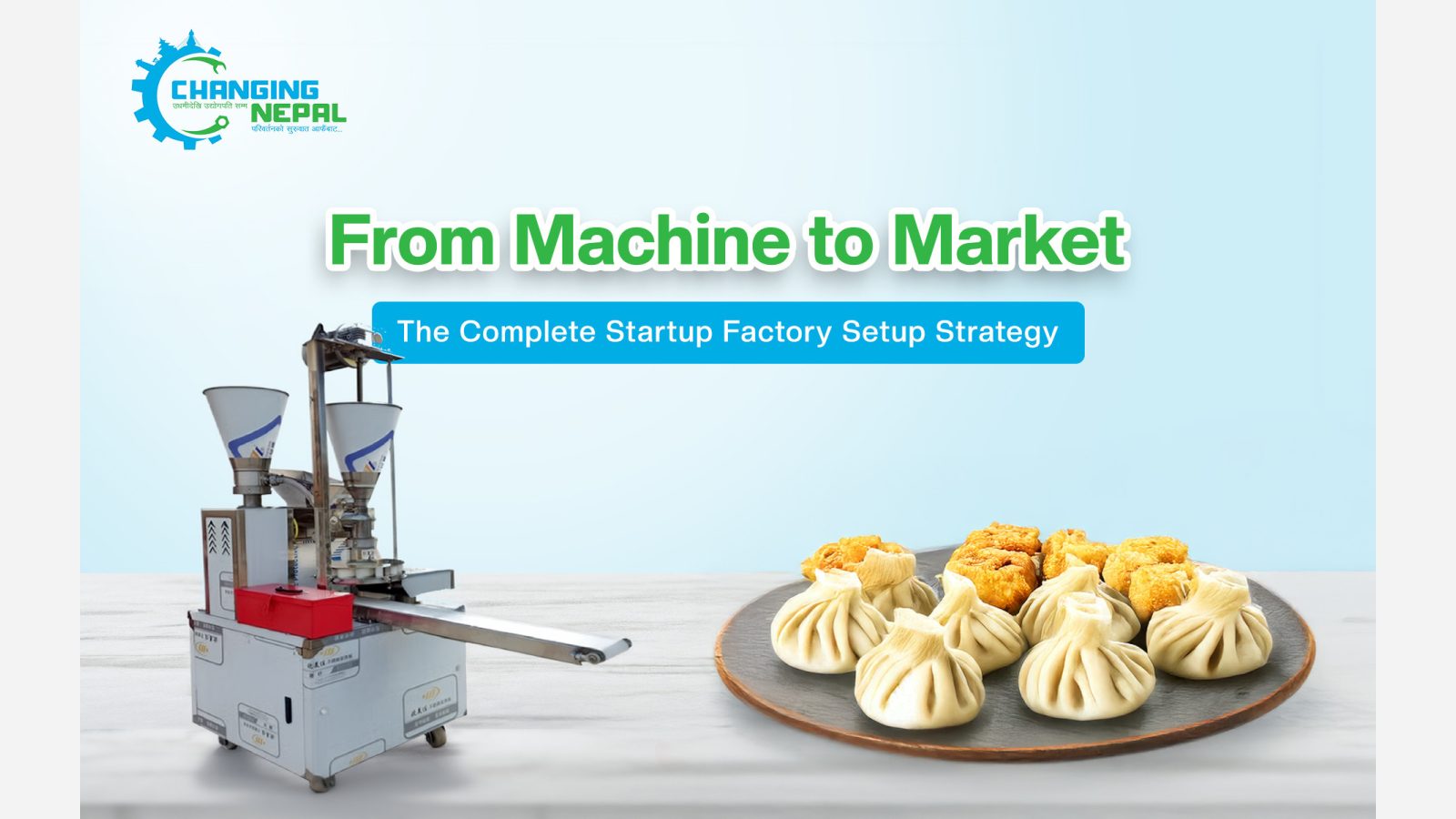
Nepal is moving out of a completely trading economy to production and manufacturing. The growing cost of imports, consumer demand, and government support for domestic industries have created opportunities for businesses that are willing to invest in manufacturing industries.
Small and medium-scale factories are on the rise around the country in food processing and packaging, paper, and construction material products. With the right planning, factory establishment in Nepal will no longer be restricted to large industrial houses.
Most entrepreneurs fail to consider purchasing machines only. To have a successful factory, it is not enough to have equipment but proper market research, legal registration, infrastructure planning, managing workforce, and an effective strategy of entering the market.
This guide will take you through the full process of machine-to-market, guiding you to strategically establish a startup factory in Nepal and create a profitable, sustainable manufacturing business.
Choosing the Right Product & Industry
The most important thing when establishing a startup factory setup in Nepal is the selection of the product and industry. Making a business strategy on the basis of trend or machine price is one of the mistakes of many investors who do not make a business choice on market demand and long-term sustainability.
Start by finding products whose demand is consistent and for which the possibility of reselling them is great. Some of the industries that are increasing in Nepal are the food processing, packing materials, paper products, and construction materials. Substitute products have high possibilities since local production would ease transportation and time of delivery.
👉 Looking for a smooth Startup Factory Setup? Changing Nepal provides the right machinery to get you started.
Market Research Before Buying Machines
Market research should be done well before investing in any industrial machinery. Many startup founders in Nepal purchase machines first and search for customers later. This is one of the biggest reasons factories struggle.
Begin by identifying your target customers. Do you distribute to wholesalers, retailers, construction companies, hotels, or distributors? Knowing who to sell to will assist you in determining the volume of production to be made, pricing strategy, and packaging requirements.
Analyze:
- Existing demand for your product in the market
- Competitors and their prices
- Distribution gaps in specific regions of Nepal
- Seasonal demand fluctuations
Selecting the Right Machinery for Your Factory
Once analysing market, the second important step is selecting the right machine for your startup factory. The type of machines that you will use is directly connected to the production capacity and the quality of products, the cost of operation, and profitability in the long run.
Start by establishing the required production volume. A very low-capacity machine can act as a constraint to growth, and over-equiped production line can impose an unwarranted burden of financial liability.
When it comes to choosing machinery, the following are some of the factors to put into consideration:
- Automation level (manual, semi-automatic, fully automatic)
- Power consumption and efficiency
- Raw material compatibility
- Spare parts availability in Nepal
- After-sales service and technical support
- Ease of operation and maintenance
Factory Location & Infrastructure Planning
The appropriate choice of the startup factory location in Nepal is a strategic choice. A good place also saves transportation costs, the supply of raw material is not a problem, and the accessibility of your target market is enhanced.
When selecting a factory site, consider:
- Proximity to raw materials
- Access to highways and transportation routes
- Availability of electricity and water supply
- Labor availability in the area
- Local municipality regulations and industrial zoning
Legal Registration & Licensing in Nepal
Your factory should be registered and adhere to the Nepal industrial laws before going into the production business plans. Effective registration will not only prevent legal hassles but also foster the trust of suppliers, banks, and customers.
1. Business Registration
Depending on the type of business idea, you would have to register your company with the Office of company registrar (OCR) or register as a sole proprietorship at your local municipality.
2. Industry Registration
When registering your startup factory with the Department of Industry (DOI) or provinces industry office. The small-scale industries may be frequently registered at the local level.
3. PAN & VAT Registration
Get a Permanent Account Number (PAN) from the Inland Revenue Department. In case you have a higher turnover than the government threshold, then you have to be registered under VAT.
4. Local Municipality Approval
In the case of your factory, you will require functional permission from the local municipality or the rural municipality where you have your startup factory set up.
5. Sector-Specific Licenses
Other licenses will be needed depending on your industry. For example:
- Food production requires approval from the Department of Food Technology and Quality Control (DFTQC).
- Manufacturing that impacts the environment may require an Initial Environmental Examination (IEE).
Power, Utilities & Technical Setup
Without good power and utility planning, a factory setup can never operate efficiently. Poor infrastructure and unstable electricity are issues that are common in Nepal. The technical setup must be carefully designed.
1. Electricity Requirements
Manufacturing equipment takes three phases of industrial power, confirm:
- Total connected load (kW requirement)
- Transformer capacity (if needed)
- Backup power options (generator or inverter system)
Machines may be damaged due to power interruptions, and this may affect productivity, so a backup system is very advisable.
2. Water Supply
Some industries can only be run with a constant supply of water, such as food processing, paper, and chemical manufacturing. There should be proper drainage and wastewater management.
3. Ventilation & Safety
Factories should have:
- Proper airflow and ventilation
- Fire safety equipment
- Emergency exits
- Adequate lighting
4. Machine Installation & Calibration
The machine ought to be installed by trained technicians. Before full-scale production can commence, proper alignment, calibration and test runs are necessary.
Technical setup goes beyond having machines installed. It is about designing an efficient production environment that helps in long-term efficiency and safety.
Hiring & Workforce Planning
A well-trained and organised workforce is essential for smooth factory setup operations in Nepal. Hiring the right number of skilled and semi-skilled employees reduces downtime, ensures product quality, and improves overall business productivity.
Nepal requires a well-trained and structured labour force to facilitate smooth operations in the factories. By recruiting the appropriate number of skilled and semi-skilled workers, downtimes are minimised, products are of quality, and overall productivity is enhanced.
Production Planning & Quality Control
Effective production planning and quality control are important to the success of any startup factory in Nepal. The best machines may not perform well without proper planning, and they may compromise on the quality of products.
1. Production Planning
- Daily Production Targets: Establish achievable targets depending on the machine capacity and the number of workers.
- Raw Material Management: Ensure timely procurement and storage of materials to prevent shortages.
- Workflow Optimisation: Organising machines, storage, and assembly space to reduce movement and wastage of time.
- Shift Scheduling: Plan work shifts to maximise output while avoiding operator fatigue.
2. Quality Control
- Standard Operating Procedures (SOPs): Establish SOPs for every step of production.
- Regular Inspections: Monitor product quality at different stages to catch defects early.
- Testing & Feedback: Test products periodically and gather feedback to maintain high standards.
- Documentation: Keep records of production batches, machine performance, and quality checks.
Branding, Packaging & Market Entry Strategy
Once production is ready, the most important thing is to come up with a brand name and how your products are going to find their way into the Nepal business market. Good branding and packaging make your startup factory setup identity and make it appealing to the customers.
1. Branding
- You should design a catchy brand name and logo that will show how your product.
- Develop a unified brand in packaging and marketing.
- Place your brand according to your target customers.
2. Packaging
- Put goods in good and attractive containers to safeguard goods and lure consumers.
- Point out important details such as product specifications, weight, and instructions.
- Eco-friendly packaging is gaining preference in Nepal, especially for food, paper, and consumer goods.
3. Market Entry Strategy
- Begin with local distributors, wholesalers, and retailers.
- Provide trial products or opening discounts to attract early buyers.
- Leverage social media, online marketplaces, and local trade fairs to expand visibility.
- Build long-term contracts with cafes, restaurants, and corporate clients for steady demand.
Common Mistakes Startup Factory Setup Owners Make
Opening a factory in Nepal can be a profitable business plan, but new entrepreneurs tend to commit avoidable errors that can stop the growth of their business. Knowledge of such pitfalls will save time and effort.
1. Ignoring Market Research
Purchasing machines without verifying the demand may translate to underutilisation of production and losses. Use social media to expand research.
2. Underestimating Investment
Not accounting for raw materials, utilities, workforce, and unexpected costs can strain finances.
Finances may be stretched by failing to consider the raw materials, utilities, workforce, and other unforeseen expenses.
3. Choosing Wrong Machinery
The choice of poor-quality machines or poor-capacity machines can raise the maintenance cost and decrease the production efficiency.
4. Poor Location & Infrastructure Planning
The operations of the factories in the areas with ineffective transport, power outages, or workforce might be problematic.
5. Neglecting Workforce Training
Staff who have not been trained can result in accidents, reduced productivity, and products of low quality.
6. Weak Branding & Distribution
Good products will not work in the absence of branding, marketing, and good distribution channels.
Conclusion:
The startup factory in Nepal is a complicated issue that needs to be planned properly concerning the choice of the correct product and equipment, registration, labour division, and market sensitisation strategy.
Those who invest time to carry out market research, make an appropriate choice of machines, cost planning, and train the workforce can make it likely to gain sustainable profits. These factors, coupled with an effective growth and reincarnation strategy, are bound to see your factory not only run effectively but also succeed in the flourishing manufacturing industry in Nepal.
Frequently Asked Questions (FAQ)
1. How much does it cost to start a small factory setup in Nepal?
Depending on the industry, machinery, and scale, a small-scale factory can cost anywhere between NPR 15 lakh and 50 lakh. High-speed automated factories may exceed NPR 1 crore.
2. Can I start a startup factory setup with limited experience?
Yes, but it is essential to hire skilled staff, invest in operator training, and seek guidance from experienced consultants or suppliers.
3. How do I choose the right machinery?
Consider production capacity, automation level, raw material compatibility, power consumption, spare parts availability, and after-sales support.
4. How do I find buyers for my startup factory products?
Combine direct sales, distributors, e-commerce, corporate contacts, or do trade fairs or local markets.
5. What are the common challenges in running a startup factory setup in Nepal?
Unstable electricity supply, high import costs for machinery, logistics delays, lack of skilled workforce, and compliance with regulatory requirements