
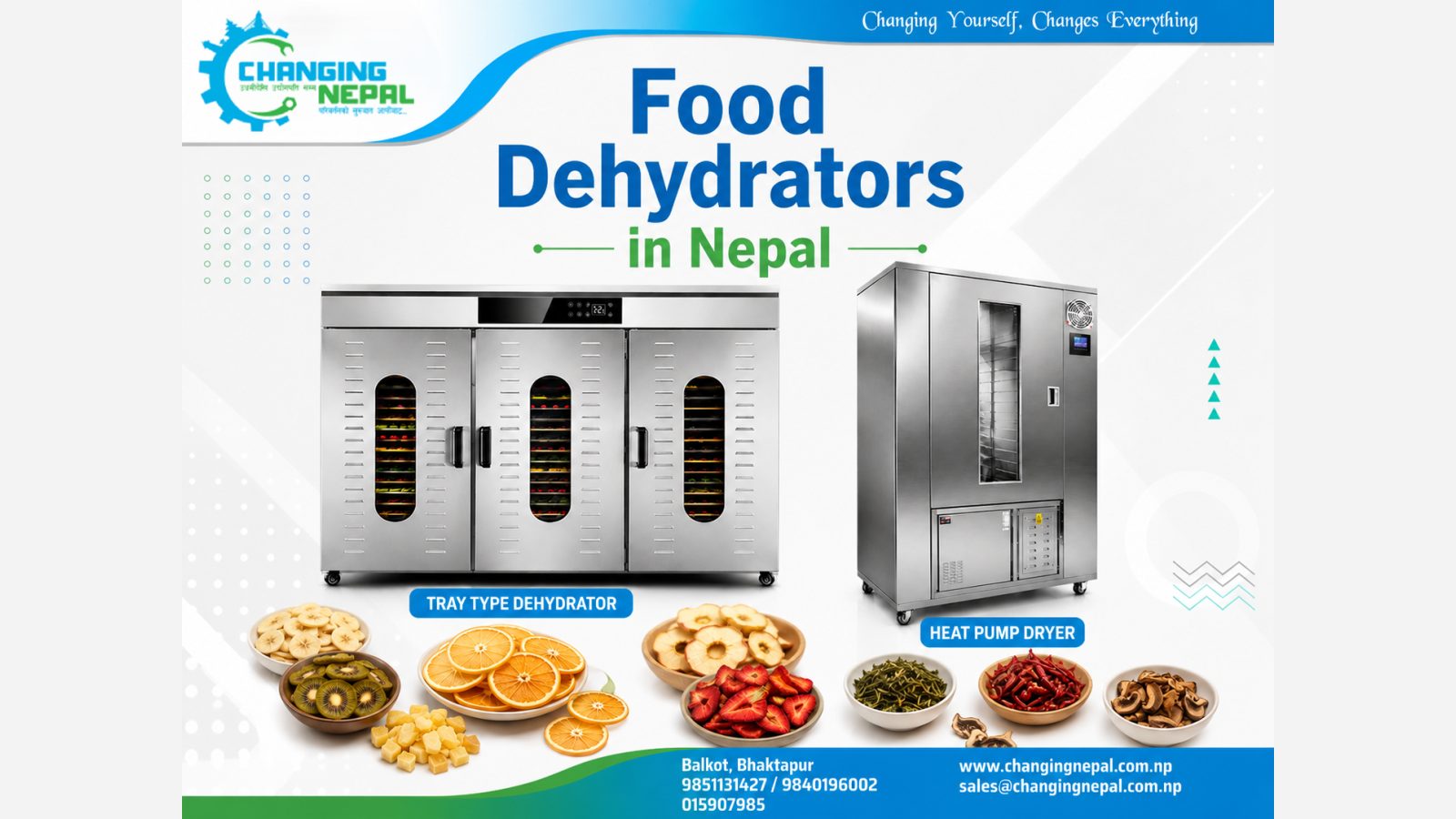
Food dehydration refers to removal of moisture from food items. A food dehydrator is a device that uses low heat and airflow to remove moisture from food. Importance of food dehydration:
- Prevents molding of food,
- Extends shelf life,
- Creates snacks like dried fruit, jerky (sukuti), and herbs.
The technique of open air sun-drying has been in practice for thousands of years. Despite being quite effective and essentially free-of-cost, it is time consuming and highly dependent on whether and season. These limitations of traditional sun-drying have encouraged the use of commercial food dryers, which provide controlled and uniform drying conditions.
This article discusses types of commercial dehydration systems, food dehydrators available in Nepal and their price.
Section Links
- Types of Dehydration Systems
- Dehydration Machines Available in Nepal
- Comparison Table
- Frequently Asked Questions (FAQs)
Types of Dehydration Systems
- Tray or Cabinet Dryer
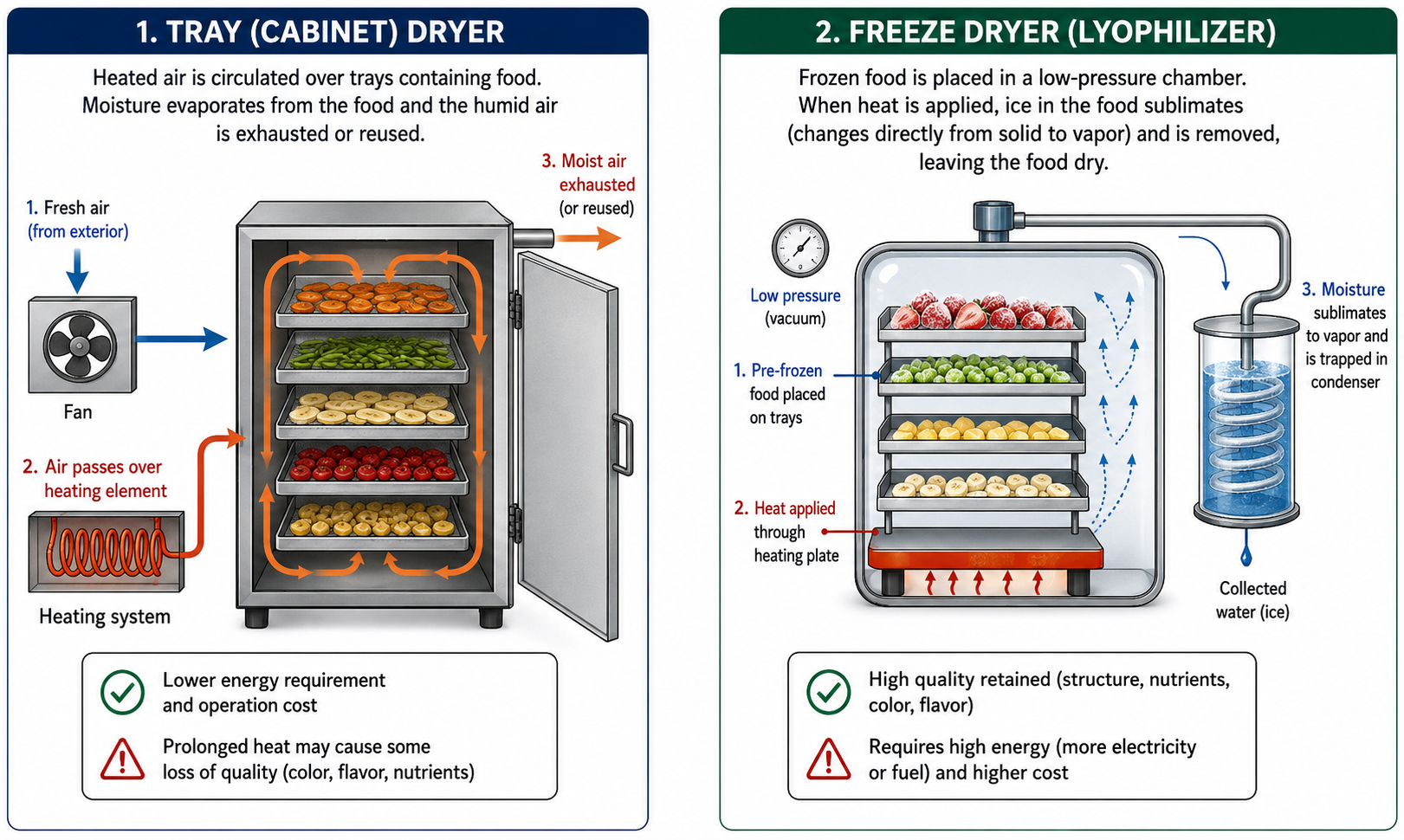
Tray dryer is the most common type of commercial dryer. Most of them consist of a fan, a heating system and trays. The fan draws fresh air from external environment which is passed over the heating element. The heated air is circulated over trays with food to be dried. As heated air heats the food, moisture inside it evaporates. The air with moisture is exhausted or reused.
Tray dryers have lower energy requirement and operation cost but, the dried food may lose some of its qualities due to prolonged heat.
- Freeze Dryer
The drying chamber consists of a heating plate and trays where food to be dried is kept. The chamber is maintained at low pressure. Pre-frozen food is placed on the plate. When heat is applied to the frozen food, moisture in the frozen food sublimates into vapor due to low pressure. Thus the food is dried.
The quality of product is retained but, it requires higher amount of energy i.e. fuel or electricity.
Machines Available in Nepal
Tray Dryer Machine
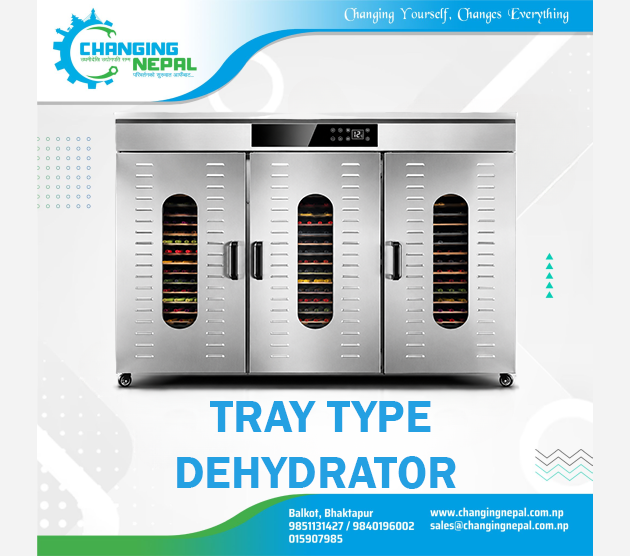
The Tray Dryer Machine is a commercial drying system used for drying food and agricultural materials by circulating heated air over trays. The machine consists of trays, a heating system, and an air circulation system. Heated air removes moisture from the product and the moist air is either exhausted or reused depending on the machine design.
Tray dryers are commonly used for drying fruits, vegetables, herbs, spices, grains, and other food materials. They are suitable for medium-scale and commercial drying operations.
| Model | Number of Trays | Power Supply | Temperature Range | Price (NPR) |
|---|---|---|---|---|
| D10 | 10 trays | 220V 1 Phase | 30°C to 90°C | 35,000 |
| D20 | 20 trays | 220V 1 Phase | 30°C to 90°C | 65,000 |
| D40 | 40 trays | 220V 1 Phase | 30°C to 90°C | 120,000 |
| D60 | 60 trays | 220V 1 Phase | 30°C to 90°C | 190,000 |
| D28 | 28 trays | 220V 1 Phase | 35°C to 90°C | 199,000 |
| D80 | 80 trays | 380V 3 Phase | 30°C to 90°C | 215,000 |
The following models are Indian stainless steel tray dryers designed for commercial and industrial drying applications. These machines feature SS tray bodies and larger chamber sizes suitable for continuous production.
| Model | Number of Trays | Machine Size (l × w × h) | Price (NPR) |
|---|---|---|---|
| D12 | 12 trays | 22 inch × 18 inch × 5 feet | 123,000 |
| D24 | 24 trays | 22 inch × 16 inch × 3 inch | 269,000 |
| D36 | 36 trays | 22 inch × 16 inch × 2 inch | 299,000 |
Tray dryers generally have lower operating cost and energy requirement compared to freeze dryers. However, prolonged heating may slightly reduce the quality, color, flavor, or nutrients of the dried product.
Heat Pump Dryer Machine
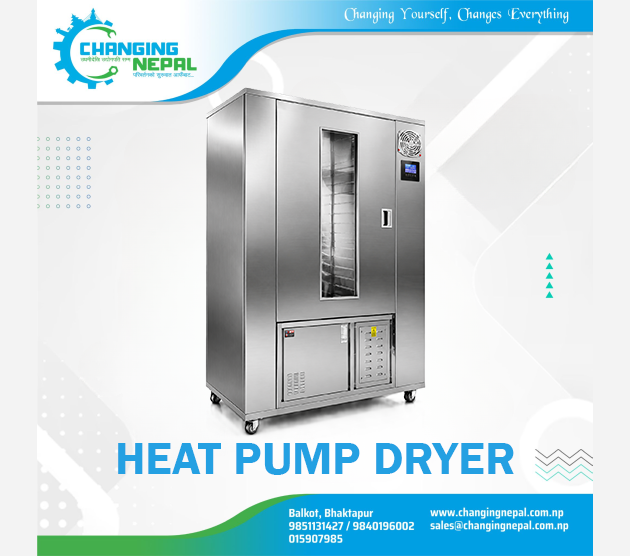
The Heat Pump Dryer Machine is an energy-efficient drying system designed for commercial food dehydration and industrial drying applications. It uses a heat pump mechanism to recycle heat inside the drying chamber, reducing energy consumption while maintaining stable drying temperature.
| Model | Main Machine Size | Tray Capacity | Material | Price (NPR) |
|---|---|---|---|---|
| WRH-10GN | 470 × 780 × 875 mm | 24 trays | Stainless Steel 304 | 699,000 |
| WRH-20BN | 1400 × 1400 × 1850 mm | 48 trays | Stainless Steel 304 | 950,000 |
Heat pump dryers are suitable for drying fruits, vegetables, herbs, spices, seafood, meat, and agricultural products while maintaining better energy efficiency compared to conventional electric dryers.
Freeze Dryer Machine
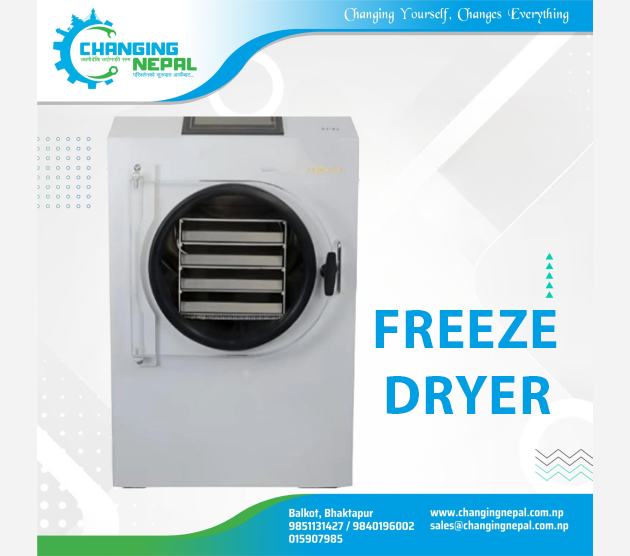
The Freeze Dryer Machine dries food by removing moisture from pre-frozen food. It helps preserve the original structure and quality of the product.
Freeze dryers are widely used for high-quality drying of fruits, vegetables, herbs, dairy products, meat products, pharmaceuticals, and research materials.
| Number of Trays | Dimension (mm) | Power | Fresh Food per Batch | Tray Space | Price (NPR) |
|---|---|---|---|---|---|
| 4 Trays | 600 × 640 × 900 | 1500W | 5–6 kg | 0.55 m² | 330,000 |
| 6 Trays | 635 × 723 × 1130 | 2000W | 8–10 kg | 0.65 m² | 545,000 |
| 8 Trays | 710 × 800 × 1500 | 2200W | 10–15 kg | 0.85 m² | 585,000 |
Freeze drying retains better product quality, structure, nutrients, flavor, and color compared to conventional drying methods. However, freeze dryers require higher energy consumption and have a higher equipment cost.
Comparison Table
| Factor | Tray Dryer Models | Heat Pump Dryer Models | Freeze Dryer Models |
|---|---|---|---|
| Price Range | NPR 35,000 – 299,000 | NPR 699,000 – 950,000 | NPR 330,000 – 585,000 |
| Tray Capacity Range | 10 – 80 trays | 24 – 48 trays | 4 – 8 trays |
| Machine Size | Compact to large cabinet models | Larger industrial units | Medium-sized enclosed systems |
| Power Requirement | Single phase and 3 phase options | Industrial power setup | 1500W – 2200W |
| Drying Capacity | Medium to high batch capacity | High commercial drying capacity | Low to medium batch capacity |
| Material Construction | Standard and stainless steel models available | Stainless Steel 304 body | Food-grade enclosed chamber |
| Best Suitable Scale | Small to commercial businesses | Commercial and industrial operations | Premium small-batch production |
| Main Advantage | Low investment cost | Energy-efficient commercial drying | Highest product quality retention |
| Main Limitation | Higher heat exposure to products | High initial investment | Lower tray capacity with high operating cost |
Frequently Asked Questions (FAQs)
1. Which food dryer is suitable for small-scale businesses?
For small-scale businesses, smaller Tray Dryer Machines such as D10 and D20 are commonly suitable options. These machines are suitable for small food processing units, local agricultural businesses, home industries, and startups with lower production requirements. The price range for small-scale food dryers generally starts from around NPR 35,000 to NPR 65,000.
2. Which food dryer is suitable for medium-scale businesses?
For medium-scale businesses, larger Tray Dryer Machines such as D40, D60, and D80 are commonly suitable. They are better for regular commercial drying operations with higher batch capacity and continuous daily production. Medium-scale food dryer setups generally range from around NPR 120,000 to NPR 299,000.
3. Which food dryer is suitable for large commercial production?
For large commercial and industrial food drying operations, Heat Pump Dryer Machines are generally more suitable. These machines provide larger drying capacity, improved energy efficiency, and better drying consistency for commercial-scale production. Large-scale commercial food dryers generally range from around NPR 699,000 to NPR 950,000.
4. Which dryer is best for premium-quality food products?
Freeze Dryer Machines are generally suitable for premium-quality dried foods where retention of structure, flavor, color, and nutrients is important. They are commonly used for high-value fruits, herbs, dairy products, pharmaceuticals, and research applications.
5. Which dryer is suitable for fruit drying?
Tray Dryer Machines, Heat Pump Dryer Machines, and Freeze Dryer Machines can all be used for drying fruits. Tray dryers are more economical, heat pump dryers provide better energy efficiency and product quality, while freeze dryers provide the highest quality retention.
6. Which dryer is suitable for making fruit powder?
For making fruit powder, fruits are generally dried first using a Tray Dryer, Heat Pump Dryer, or Freeze Dryer, and then ground using a pulverizer or grinding machine. Freeze-dried fruits are often easier to convert into high-quality powder with better nutrient retention.
7. What products can be dried using these machines?
These food dehydrators can dry a wide range of products including fruits, vegetables, herbs, spices, mushrooms, grains, meat, fish, dairy products, medicinal plants, flowers, seafood, and agricultural materials.
8. What is the main difference between tray dryers, heat pump dryers, and freeze dryers?
Tray dryers use heated air circulation and are generally more affordable. Heat pump dryers recycle heat for better energy efficiency and controlled drying. Freeze dryers remove moisture from frozen food under low pressure and provide the highest product quality retention.
9. Does food dehydration affect nutritional value?
Some nutrient loss may occur during hot-air drying due to heat exposure, especially in conventional tray dryers. Heat pump dryers generally preserve more quality due to lower drying temperatures, while freeze dryers retain the highest amount of nutrients, flavor, color, and structure.