
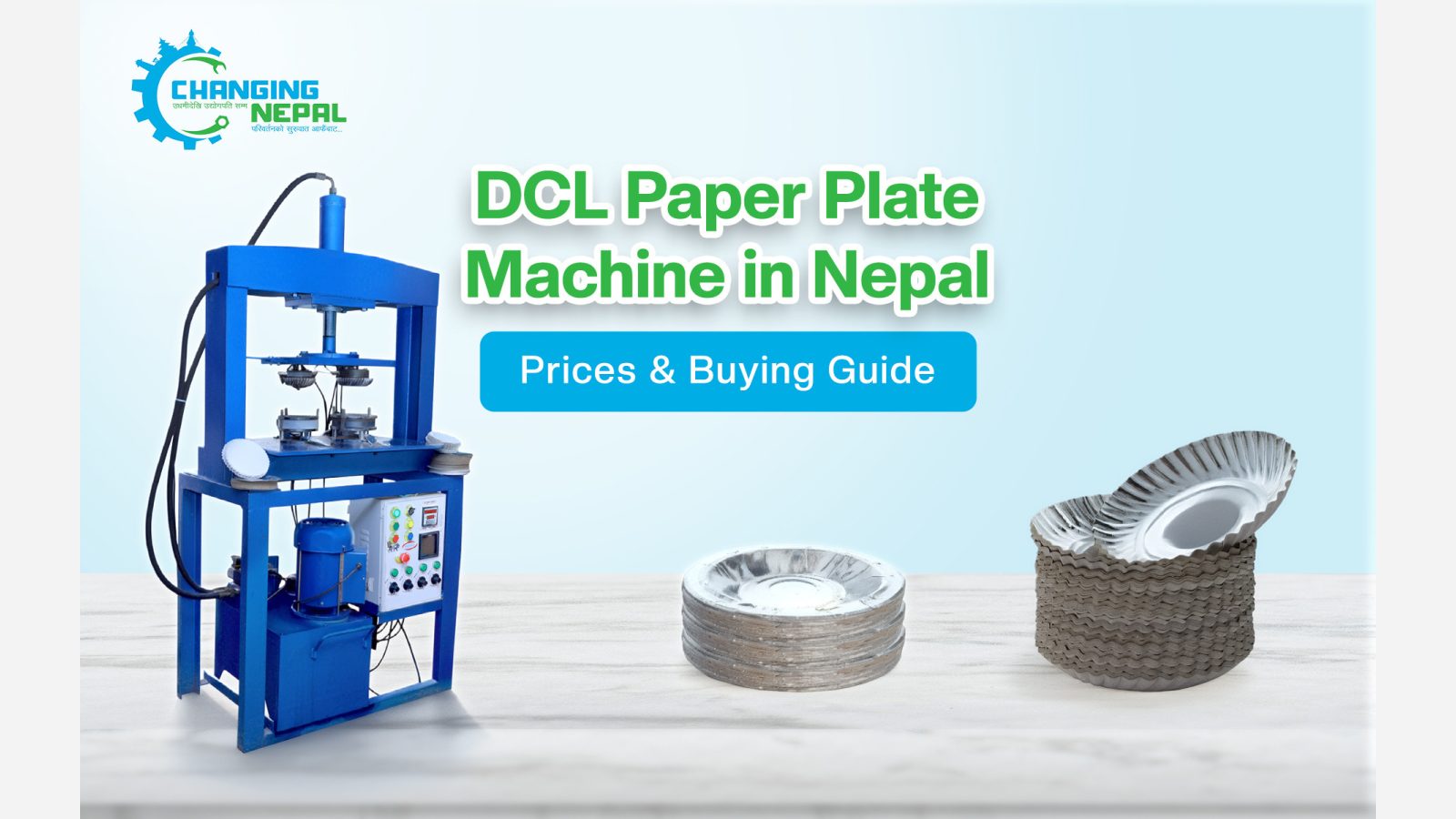
The paper plate business is booming in Nepal as most hotels, fast food shops, catering services, parties, and programmes use disposable plates daily.
Paper plates are easy to use, are light to carry around,d and are better for quick food service. Because of this, many people are now interested in starting a paper plate-making business.
Before purchasing a machine, it is essential to know the cost, machine type, production capacity, features, and after-sales support. Not all machines can be used for all businesses. Some are better for small production, while others are made for large commercial use.
In this guide, we will try to put all in simple, easy words, like what a DCL paper plate machine is, the price of a DCL paper plate machine, the important features of a DCL paper plate machine, and the best DCL paper plate machine to choose the best machine for your business.
What is a DCL Paper Plate Machine?
A DCL paper plate machine is a machine that is used to produce paper plates from paper sheets or paper rolls. It shapes the paper and forms the paper into plates with the help of heat, pressure, and a die. The machine can create different-sized plates, depending on the type of die that is used.
This machine is useful for businesses that want to make disposable paper plates for food service, events, street food shops, restaurants, and catering work. Since paper plate is used in many places every day, this machine can help in starting a small or medium-sized manufacturing business.
The working process is very simple. First, the paper material is put into the machine. Then, the machine presses and cuts the paper into the shape of a plate.
After that, the plate that is ready comes out of the machine. Some machines do this process slowly and require more manual work; others do this faster and more automatically.
DCL paper plate machines are popular because they are designed to make production easier, faster, and more organised. They can help to reduce the costs of labour and improve output.
Depending on the machine, it can be used for small businesses or larger production units.
Boost your production with reliable and high-speed DCL Paper Plate Machines. Get yours today from Changing Nepal.
Why DCL Paper Plate Machines Are Popular in Nepal?
The DCL paper plate machine is also getting popular in Nepal, as the demand for the disposable paper plate machine is increasing in many areas.
Restaurants, food stalls, catering businesses, party organizers,s and event companies make use of paper plates daily. This results in a good business opportunity for people who are interested in starting a small production business.
One of the chief reasons for their popularity is that these machines are useful in small and medium-sized businesses. Many people want to start a business that does not require a very large initial investment.
A paper plate machine can be a practical option due to its role in making items that are utilised on a regular basis in the market.
Another reason for this is that paper plates are easy to sell. They are used generally in fast food shops, tea shops, school events, offices, religious programs, weddings, and local festivals.
Since these products are required in many areas, paper plate production looks like a good venture for the business owner to get into the manufacturing sector.
DCL paper plate machines are also popular because they are useful for saving time and better production speed.
Instead of products being made by hand, the machine is able to produce paper plates more quickly and consistently. This helps businesses to meet customer demand more easily.
Types of DCL Paper Plate Machines Available in Nepal
Different types of DCL paper plate machines can be seen in Nepal. The right machine is based on your budget, production goal and your business size. Some machines are good for small startups, while others work better for bigger production work.
Manual Paper Plate Machine
A manual paper plate machine requires more human power to run. The user has to do more work during the production process.
This type of machine is typically better for very small businesses or beginners who would like to start with a low budget. Its production speed is less than that of other machines, but this machine can be useful for small orders.
Semi-Automatic Paper Plate Machine
A semi-automatic machine is one of the most popular options for small and medium businesses. It does some of the work automatically, but still requires some manual support.
This machine is a good compromise between price and productivity. Many business owners go for this type because it is easier to manage and provides better output than a manual machine.
Automatic Paper Plate Machine
A semi-automatic machine is one of the most popular options for small and medium businesses. It does some of the work automatically, but still requires some manual support.
This machine provides a reasonable price-to-productivity ratio. Many business owners prefer this type because it is easier to manage and it allows for better output than a manual machine.
Single Die Machine
A single die machine has only one die, which is used to produce one size or one shape of plate at a time. It is easy to use, and it is for businesses that want to concentrate on one type of product.
This machine can be a good choice for small-scale production units.
Double Die Machine
The double die machine is able to produce more plates in less time as it has two dies. This aids production capacity improvement. It is often chosen by businesses that have a need for more output and have a larger market to satisfy.
DCL Paper Plate Machine Price in Nepal
The price of the DCL paper plate machine in Nepal typically depends on the model of the machine, production capacity, and level of automation.
On Changing Nepal's website, the price range of the DCL Paper Plate product is NPR 130,000 to NPR 215,000.
Key Features to Check Before Buying
Before you buy a DCL Paper plate machine, you should check a few important features. These features help you know whether the machine is right for your business or not.
Production Capacity
One of the first things to check is how many plates the machine can make in one hour.
A single mold crank machine can typically produce about 900 to 1200 pieces an hour, and a double die crank machine can produce about 1800 to 2400 pieces an hour.
If the amount of production your business requires daily is larger, a larger-capacity machine will be a better choice.
Plate Size Range
You should also check what plate sizes the machine can make. On Changing Nepal's product information, common paper plate machines are written to support from around 4 inches to 12 inches.
This is important since some buyers only require small DONA or Momo plate sizes, while others also require more thali sizes.
Power Requirement
Power use is also an important point. A single-die crank machine is listed at approximately 2kW, 220V, and a double-die crank machine is listed at approximately 2.6kW, 220V.
Before you purchase, ensure your workspace is integrated with the proper power supply for the machine to be able to function.
Machine Body and Build Quality
A strong machine body is important for long-term use. The heavier or better-built models usually have better stability while production is going on.
Changing Nepal also emphasises versions like high-quality channel body machines and double motor models, which implies that the build quality and machine structure can have an impact on performance and durability.
Ease of Operation
A good machine should be easy to use, especially for new business owners. Semi-automatic crank machines are often preferred as they provide a reasonable balance between the cost and the output, considering how easy it is to handle the machine for one person.
This makes them a logical choice for many small and medium-sized businesses in Nepal.
Spare Parts and Service Support
Before purchasing, it is also important to inquire about spare parts, maintenance, and support after buying. A machine may appear to be affordable at first, but if parts are difficult to source later on, it can cause problems for the business.
Changing Nepal is offering spare parts supply, maintenance support, installation, and training as part of their service offering. Buyers should check for the same before taking a final decision.
How to Choose the Right DCL Paper Plate Machine?
Choosing the Right DCL Paper Plate Machine. Depending on your budget, how much you want to produce daily, and the size of your business, you can choose the right DCL paper plate machine.
Changing Nepal has listed some DCL models, which include single-die automatic, double-die automatic, single-cylinder semi-automatic,o and double-cylinder semi-automatic.
This means different choices by buyers depending on how much they want to produce and how much they want to invest.
Choose Based on Your Budget
If you are going to start a small business and want to be able to control costs, a simpler model is usually a better option. On Changing Nepal's website, the DCL paper plate range appears to be NPR 130,000 to NPR 215,000 (though other paper plate machines on the website also indicate that lower capacity machines are likely to be cheaper than higher capacity ones).
This makes budget one of the first things to consider before making a purchase.
Choose Based on Production Need
If you merely need a smaller number of plates a day, you may not need to have more than a single-die machine or a lower-capacity plate.
If you would like to get faster work and bigger output, then a double die or double cylinder model might be more suitable.
Changing Nepal's product and blog pages both indicate that machine type and die setup are directly related to the level of production.
Choose Based on Business Size
For a new or small business, a semi-automatic machine may be a workable option since it is easier to manage and usually more affordable.
For a growing business requiring regular and high-volume supply, an automatic model can save time and a lot of manual work.
Changing Nepal's paper plate machine also offers semi-model and auto-model price differentials, which support this practical buying approach.
Check the Plate Sizes You Want to Make
Before purchasing, ensure the machine supports the plate sizes that your customers require.
The site also lists the paper plate dies and molds for different size ranges, such as 4 to 8 inch, 9 to 12 in, ch and wrinkle plate options.
This is important because some businesses need small snack plates and some need the larger thali sizes.
Think About Future Growth
It is also smart to think outside your immediate needs. A low-cost machine may suffice today, but if demand is growing rapidly, you may want a machine with greater output at a later date.
Many purchasers opt for a machine that accommodates both their current budget and business plan down the road.
Especially if they wish to expand into restaurants, catering, events, or the local wholesale supply. The paper plate business articles on the site make the machines fit for entrepreneurs and small manufacturers in Nepal.
Do Not Ignore Service and Spare Parts
A machine is not just a matter of price. You should also ask whether there are spare parts and maintenance help, installation, and training after purchase.
This is important as good after-sales support can save time and help avoid business problems later. Changing Nepal is a promoter of machinery guidance and support as part of the overall service provisioning.
Raw Materials Needed for Paper Plate Production
To get paper plate production going, you need more than just the machine. You also need the right raw materials, as well as a few things to support it.
The quality of these materials has an effect on the quality of the final plate, the production speed, and the overall cost of business.
Paper Roll or Paper Sheet
The primary raw material for use in making paper plates is a paper roll or paper sheet. Changing Nepal's paper plate guide states that paper plates are usually made from continuous paper rolls.
Duna Thali machine also states that laminated paper rolls and silver or golden paper are common materials. This means that buyers should select the paper material according to the type of plate they would like to make.
Die and Mold
A die or mold is also required since it gives the plate its shape and size. Changing Nepal lists different die options for different types of dies, such as dona dies, wrinkle dies, saal leaf plate dies, auto wrinkle dies, and different sizes like 4 to 8 inch, 9 to 12 inch, and 5 to 9 inch based on the types.
This is important because the die determines what type of plate your machine is capable of making.
Printed or Special Paper Material
Some businesses utilise plain paper material while others use laminated, silver,r or golden paper for better looks or specific needs in the food use case.
Changing Nepal's Duna Thali article mentions these materials as common options in this form of production.
This can help businesses in choosing products for events within the local area, food shops, or special demands from customers.
Packaging Materials
After these plates are made, they also have to be packed properly. Businesses typically require simple packaging materials such as plastic wrap, bags, or bundles for storage and delivery.
Good packaging helps to keep the plates clean and safe and ready to sell. This is a practical portion of the production, especially if supplying hotels, shops,s or event businesses.
Electricity and Workspace
You also need a proper place for running the machine. The changing Nepal Single Mold and Double Mold Paper Plate Machine are listed with the power requirements of 220V, which means that buyers should ensure they have the proper electricity setup before beginning production.
A clean area that is big enough to accommodate the machine, raw materials, and packing area will make the work easier.
Benefits of Starting a Paper Plate Business in Nepal
Starting a paper plate business in Nepal can be a good choice for those who are looking to start a small-scale manufacturing business.
Changing Nepal consists of paper plate production as a growing opportunity because paper plates are used in food shops, events, family functions, and street businesses.
The local market still has room for more production. The site also gives this business as being appropriate for small enterprises and manufacturers who want to supply everyday disposable products.
Growing Demand in the Market
One significant advantage is the increasing demand. Paper plates are used in many places, such as a tea shop, snack shop, catering, religious, and social functions, etc.
Changing the piece of content in Nepal is also related to the increasing interest in paper and other disposable plate products, and people's desire for eco-friendly products, which is why this kind of business is more relevant in today's market.
Good Option for Small and Medium Investments
Another plus point is that this business can be started on a small or medium level. The site has different machine types and price ranges, meaning that buyers can start with an easier setup and expand later on.
This renders the business more flexible for new investors who do not want to start with a very large factory.
Easy Product to Sell
Paper plates are utilitarian products, and therefore, they are easier to market in comparison to many highly specialised products.
The use of the products in serving snacks, fruits, chaat, pani puri, and serving events indicates that the products have numerous target customers within the domestic market.
This broad application is capable of assisting business owners in acquiring buyers with ease.
Chance to Grow Over Time
It is also possible to expand a paper plate business step by step. Basic production can be adopted in a small unit and later become more capacity-based on the demand.
The alteration of the overall manufacturing content of Nepal underlines the development of the small-scale manufacturing machines in Nepal and indicates the rising demand for local products, which can justify the fact that the emergence of new enterprises is subject to expansion in the long run.
Supports Local Production
The other notable advantage is that it promotes local production in Nepal. The article from the changing Nepal about the business reported an increase in the cost of transportation of imported goods, and also interest in producing locally made products.
Due to this fact, it is possible to create a business model of producing paper plates within Nepal and supply them locally.
Better Fit for Today’s Market
Another future-proof and future-oriented industry that is introduced by the site is the eco-friendly plate production.
It further provides the paper plate business with an added advantage, as a large number of customers and businesses currently favour products that are more environmentally friendly compared to their plastic counterparts.
Common Mistakes to Avoid When Buying a Paper Plate Machine
Purchase of a paper plate machine is a significant business choice. Price is not enough, as many buyers consider only price. A machine must fit your production target, type of product, a nd business strategy.
The customers must weigh between machine models, volume of production, and type of plates before the final selection is made.
Choosing Only by Low Price
The most frequent mistake is purchasing the cheapest machine without looking at its capabilities. A machine that is priced low might appear good in the initial stages, yet it might have reduced output, features, or sizes.
Some are simpler crank machines, others are more hydraulic models or automatic models, and the prices go up as the machine capacity increases.
Not Checking Production Capacity
The other error is not considering the number of plates that the machine is capable of producing within one hour. When you have frequent orders in your business, then a machine of low capacity will slow down the production.
A machine used in Nepal gives a single-mold crank machine at approximately 900-1200 pieces/hours and two die machine at approximately 1800-2400 pieces/hours, and these figures demonstrate why production capacity is a factor before purchase.
Buying the Wrong Machine for the Product Type
Machines do not suit all products the same. Some buyers require dona, buyers who require thali, buyers who require wrinkle plates, or various sizes. The buyers need to determine what they need as their main plate first, and then they can decide which machine to buy.
This is significant in that the type of die, model of the machine,e and the way it would be set up all determine what product you would like to make.
Ignoring Die Size and Plate Size Needs
You can have a good machine, but it might not accommodate the size of plates that your customers desire. Some machines serve smaller snack plates, and those that serve bigger sizes that reach 12 inches.
Unless you check the compatibility of size prior to purchase, the machine might not suit your market demand.
The reforming of Nepal demonstrates that the size of the die and machine model is directly related to the size of the plates that you can make.
Not Asking About Spare Parts and Support
Other customers buy a machine without inquiring about the spare parts, maintenance assistance, installation,ord training. This may cause issues in the long term if the machine needs to be repaired or adjusted.
It is always prudent to enquire of the supplier about the after-sales support before making purchases. The website offers service support, spare parts, and installation-related assistance as part of its business offer.
Not Thinking About Future Business Growth
Something good today might not be good tomorrow. A large number of businesses begin small, and later they require increased output as the number of orders increases.
When you purchase the machine with a very small capacity, there may be a possibility that you will be forced to change it much earlier than anticipated.
The redesign of Nepal's product range consists of several DCL models with various die and cylinder variations, and this implies that the purchaser must consider the current and future business requirements.
Why Buy from Changing Nepal?
Changing Nepal can be a good alternative to businesses that desire a local supplier of goods in Nepal.
The company gives its office address as Ragini Height, Balkot Chowk, Bhaktapur, Nepal, and the details are displayed on its web page, which contains direct contact information for sales and machine enquiries.
This enhances the ease with which buyers can enquire about the models of the machines, price, and availability before purchasing.
The other consideration to make with Changing Nepal is that it provides various machinery within the Paper-Based Machinery, with one being the DCL Paper Plate machine.
There are also several machine options displayed in the DCL product page with a price range listed between Rs 130000 and Rs 215000, and this assists the buyer in comparing options with the budget and the production requirement.
Services that are worth purchasing after purchasing a machine are also revealed in Changing Nepal.
The company mentions on the homepage that it offers spare parts, maintenance, and after-sales services, installation, training, and machine delivery to the whole of Nepal.
The services are useful since buyers usually require services not only when they are making the purchase, but also in the future when they are setting up the purchase, and also when they are using it regularly.
Conclusion
The DCL paper plate machine can be an excellent option for individuals who are interested in entering or expanding a paper plate company in Nepal.
It can be used to create sheets of paper of various sizes, and it may assist in enhancing the production speed, minimising the number of people working manually, and assisting in meeting the needs of a business daily.
Price, type of machine, capacity of production, range of plate sizes, power needed, and provision of after-sales services are some of the factors that should be viewed before purchasing a machine.
A simple model can be used when starting a small business, and a more advanced machine can be required in a bigger business.
Another important thing to consider is to purchase a supplier who would offer appropriate guidance, spares, and post-purchase services. This will allow your business to be able to operate more efficiently in the long term.
Frequently Asked Questions
1. What is the price of a DCL paper plate machine in Nepal?
The DCL Paper Plate machine is priced at Rs 130,000 to Rs 215000 as listed on Changing Nepal. The price will be determined by the model, die setup, and machine features.
2. What types of DCL paper plate machines are available?
Changing Nepal enumerates some of the DCL models, such as single die automatic, two die automatic, single cylinder semi-automatic, and two cylinder semi-automatic machines. This will provide buyers with choices of small, medium, or increased production requirements.
3. Which machine is better for a small business?
A smaller or less robust model can be a good start with a small business since it would be less complicated and require less investment in management.
As demonstrated in the paper plate guide on the site, single-mold machines also have less output and are well placed to produce less when compared to the two-die machines.
4. How many paper plates can a machine make in one hour?
The guide to changing Nepal states that a single-mold crank machine can make approximately 900 to 1200 pieces/hour, whereas a double-die machine can make approximately 1800 to 2400 pieces/hour. The machine type and model are dependent on production.
5. What plate sizes can these machines make?
The information on changing the paper plate guide of Nepal says that the usual paper plate machineries are able to produce plates of about 4 inches to 12 inches. The correct size will be determined by the die and machine model.
6. What raw material is needed for paper plate production?
Paper is the primary raw material, which is normally fed to the machine in large rolls or continuous sheets. The paper is then sliced and stamped into the desired form of a plate.
7. Does the machine need a special power supply?
According to the paper plate guide, the single-mold crank model runs on approximately 2 KW of power, and 220 V, and the double-die crank models are depicted at approximately 2.6 KW and 220 V. Purchasers ought to ensure that their workstations are properly equipped with an appropriate electricity system.