
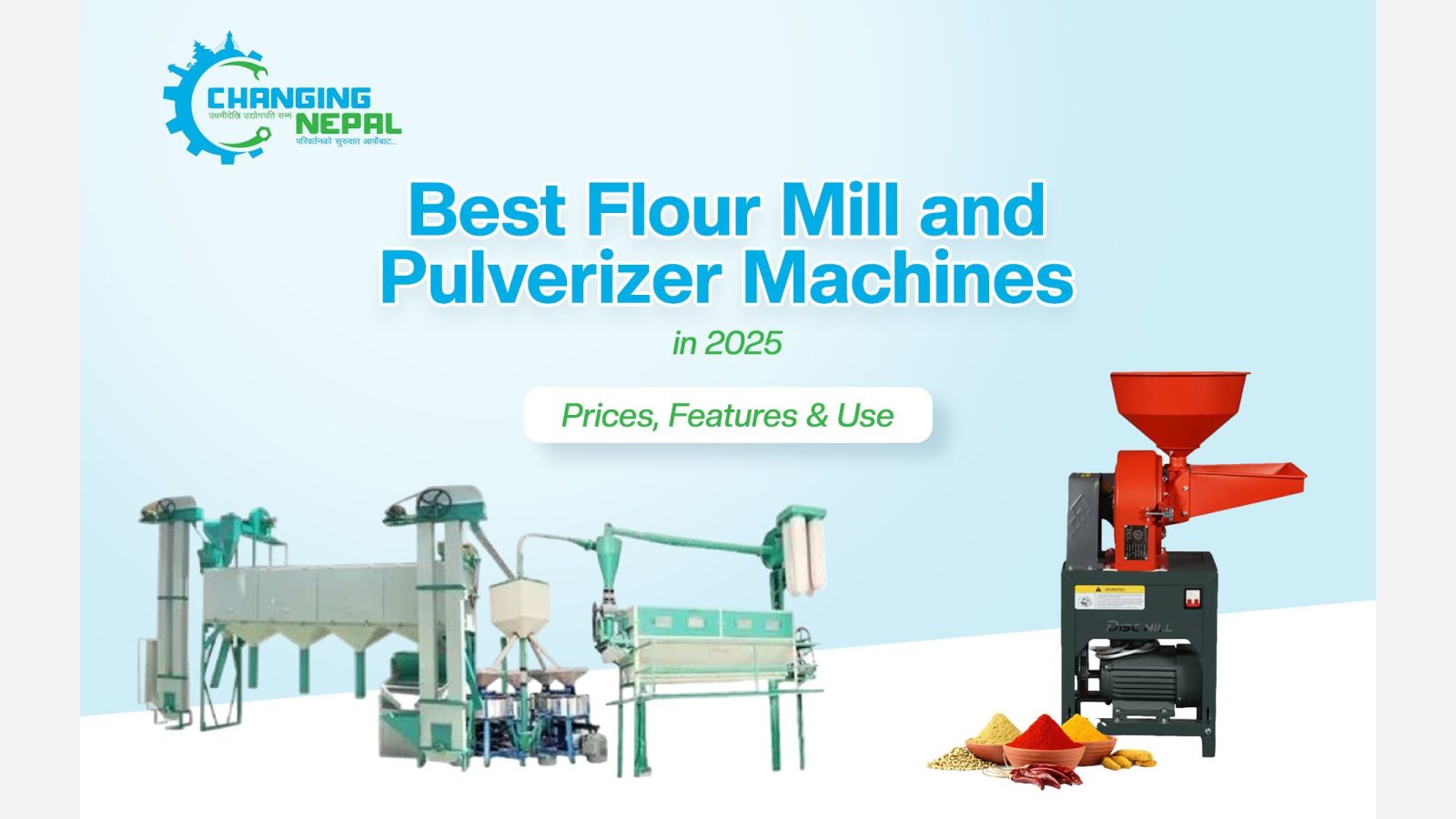
The year 2025 has seen some exciting breakthroughs in the technology of flour mills and pulverizers, making it easier for Nepalese households, small-scale industry, and large-scale manufacturing plants to access highly efficient milling at a competitive price. Whether you are a home baker looking for an affordable domestic flour mill or a businessman in the food and agriculture industry looking for a heavy-duty pulverizer, understanding the latest models, their prices, and features will be a big help in your decision-making process.
In this guide, you will cover price insights, feature comparisons, notable brands, and maintenance tips, all of which tie into data derived from the broader industry trends.
Why Choose the Right Flour Mill or Pulverizer in 2025?
With the rising demand in Nepal for fresh, preservative-free flour and spice powders, the right machine will be able to:
- Reduce processing costs in the long run.
- Ensure texture and quality consistency,
- Improve operational efficiency using smart automation,
- Cater to a wide range of products—from wheat (gahu) and maize (makai) to masala ingredients like dhaniya, jira, and chilly.
Machines with adjustable jali sizes allow for more versatility, letting you switch between fine powder and coarser grinds.
Key Features to Consider When Buying Flour Mills
1. Production Capacity and Efficiency
Capacity matching is key to the successful running of the flour mill operation. Small-scale operations usually require 10-50 kg/hr capacity, commercial projects may be 100-500 kg/hr or even larger. The cost-capacity and price relationship generally follows the pattern, but the efficiency is different with different machine designs and manufacturers.
With the rise in the cost of electricity, energy efficiency has become more critical. The modern flour mills have improved designs of motors and more efficient milling systems, reducing power usage per ton of flour manufactured. High-tech automation with modern sophistication ensures uniform quality consistency without wastage of energy for the wrong reasons.
2. Build Quality and Materials
The use of stainless steel construction is essential for food safety and durability, more so for all contact surfaces. While mild steel bodies are acceptable for support structures, all grain-contact surfaces must use food-grade stainless steel to avoid contamination and ensure easy cleaning.
Precision engineering plays a major role in the quality of the flour and the longevity of the machine. Quality machines feature well-balanced grinding units with precision-machined parts and sturdy bearing systems, ensuring consistent operation over many years.
Price Guide for Flour Mills and Pulverizers in Nepal (2025)
Below is a comparison table based on the latest Change in Nepal Pvt. Ltd., showing popular models and their specifications:
| Machine Type & Model | Motor Power | Capacity (per hr) | Price (NPR) | Notable Features |
|---|---|---|---|---|
| Disc Mill | 3 HP | Up to 150 kg | 28,000 | Multi-grain & masala grinding |
| Suction Type Pulveriser | 3 HP | Up to 150 kg | 40,000 | Efficient suction design |
| Masala Making Machine | - | - | 68,000 | Vertical type; extra blade cost 1,000 |
| 2 in 1 SS Pulveriser (Delux, 2 HP) | 2 HP | 12–15 kg | 50,000 | Spices & grains |
| 2 in 1 SS Pulveriser (Delux, 3 HP) | 3 HP | 20–25 kg | 55,000 | Higher capacity home/commercial |
| 2 in 1 SS Pulveriser (Jambo, 3 HP) | 3 HP | 30–32 kg | 75,000 | Double chamber |
| 2 in 1 SS Pulveriser (5 HP) | 5 HP | 40–45 kg | 95,000 | Three-phase heavy use |
| 2 in 1 SS Pulveriser (10 HP) | 10 HP | 65–80 kg | 1,65,000 | Industrial capacity |
| MS Pulveriser (8 inch) | - | 15–20 kg | 30,000 | Single chamber |
| Heavy MS Blower Type Pulveriser (10 HP) | 10 HP | 80–90 kg | 2,85,000 | High-volume industrial model |
Types of Flour Mill Machines Available in Nepal
Stone Mills vs. Modern Roller Mills
Traditional stone mills are still in use in Nepal for their ability to produce very fine stone-ground flour that retains the natural mineral and nutrient content. However, modern roller mills have gained a very high status in modern commercial flour production due to their efficiency and consistency. The roller mills, which crush and grind the grains under rollers, therefore, have more control over the particle size of the flour as well as a far better throughput than these traditional methods.
Impact mills or hammer mills are becoming more popular for commercial use in various high-speed grinding processes. With rotating hammers striking the grains and breaking them into fine particles, this machine can work on a variety of grains and is very versatile. Due to their flexibility and speed, impact mills are most desirable for commercial applications where steady production is necessary.
Home Flour Mill Machines
Home flour mill machines are characterized by motors of 1-3 HP and an hourly output capacity of 8-15 kg. These are small machines primarily designed for household and small-scale use. Some of the popular models include:
1 HP Domestic Flour Mills: Priced around NPR 20,000-25,000, offering 8-10 kg/hr grinding capacity
3 HP Multipurpose Grinders: Available for NPR 103,500-115,000, providing 35-90 kg capacity with 2800 rpm speed
Commercial Flour Mill Equipment: Power and Efficiency
Medium-Scale Commercial Operations
Medium-scale flour mills can provide huge capacity boosts to rapidly growing businesses without the necessity for a huge capital investment. These systems typically present:
i) 5-10 HP Commercial Mills: Capacity is 50-100 kg/hr, depending on material and sieve size, suitable for local markets and small flour distribution businesses. Features of these machines include:
- Dual chamber systems for different grain types
- Stainless steel construction for food safety
- Variable speed controls for different fineness levels
ii) 15-25 HP Industrial Mills: The mills are suitable for serious commercial applications and can grind 140-200 kg/hr, depending on the material and sieve size. Mild steel bodies and powder coating for the finishing are employed for the mills for improved durability.
Large-Scale Industrial Flour Mills
Industrial flour processing plants in Nepal are adopting cutting-edge technology to compete globally. Companies like SR Foods operate 200 TPD (tons per day) facilities using 100% BUHLER technology from Switzerland. These operations include:
- Self-cleaning systems with magnetic separators, vibrating sieves, and destoners
- WinCos R2 software for complete plant automation and optimization
- Food quality stainless steel conveying systems for preserving the quality of products
- Metal silos with automatic cooling systems for raw material storage
Pulverizer Machines: Versatility in Grinding
Basic Pulverizer Models
Disc mills are the simplest pulverizer technology, which can grind most of the materials, such as masala ingredients, wheat, maize, and rice. With capacities up to 150 kg/hr and with 3 HP motors, the equipment provides an excellent value at about NPR 28,000 without the cost of the motor.
The suction-type pulverizers have highly efficient blowers that automatically pull in the material into the grinding chamber. The improved design of this pulverizer saves on labour time and offers sieve longevity 5 times by virtue of specially designed secondary crushing mechanisms. Costing NPR 40,000 for 3 HP models, the pulverizers are worth buying for domestic applications and small-scale commercial use.
Advanced Pulverizer Systems
2-in-1 Stainless Steel Pulverizers offer remarkable versatility, capable of grinding spices, fresh ginger, garlic, sugar, fruits, vegetables, and even cattle feed. These machines also function as flour mills for wheat and maize. The price range varies significantly based on power and capacity:
Heavy-duty blower-type pulverizers are the state of the art in grinding technology with hammer and cutter mechanisms and built-in blowing systems. These machines are built for continuous commercial working:
- 2 HP models: NPR 80,000 (15-20 kg capacity)
- 10 HP three-phase: NPR 285,000 (80-90 kg capacity)
Safety and Maintenance Features
Modern flour mills include essential safety features such as:
- Emergency stop mechanisms for immediate shutdown
- Overload protection to prevent damage to the motor
- Dust collection systems to maintain clean working environments
- Easy access panels for routine cleaning and maintenance
Nepal's Leading Flour Mill Brands and Suppliers
Established Commercial Brands
i) SR Foods is a technology pioneer with the most modern Swiss equipment and the latest software quality control systems. It is HACCP 22000:2005 certified, which demonstrates the company's global adherence to food safety guidelines. The company produces various kinds of flour, including wheat flour, fine flour, coarse wheat flour, and special flour for the government nutrition programs.
ii) Vikas Food Products in Nepalgunj operates on a gigantic level with a 150-tonne-per-day per day mill flour output and a 100-tonne-per-day per day wheat atta production. Its outputs have received worldwide recognition, with the company's Chakki Atta reaching as far as the UAE, Singapore, and China, demonstrating the quality achievable with appropriate equipment and management.
iii) Ramailo has become the biggest quality flour miller in Nepal with more than 20 years of experience in the industry. They are dedicated to quality with in-house testing procedures and world-class after-sales service for the clients.
Regional Equipment Suppliers
Muktinath Krishi Company offers domestic-scale solutions with their 3 HP flour mills providing 100-120 kg/hr capacity. These machines feature disc-type grinding mechanisms in compact designs suitable for small-scale operations.
Local Nepali suppliers offer multiple imported and locally assembled choices, with prices varying substantially according to specifications and quality of build. The competitive landscape allows the buyer to have multiple choices for each budget and capacity requirement.
Price Analysis and Market Trends
Current Pricing Structure
Entry-level machines start around NPR 20,000-30,000 for basic domestic mills, while commercial-grade equipment ranges from NPR 50,000 to several million rupees for complete processing plants. The price-to-capacity ratio varies significantly:
- Basic disc mills: NPR 187 per kg/hr capacity
- Commercial Pulverizers: NPR 2,000-4,000 per kg/hr capacity
- Industrial systems: NPR 10,000+ per kg/hr for complete processing lines
Financing and payment terms have become more flexible, with many suppliers offering installment plans. Changing Nepal requires a 30% advance payment for imported equipment, 40% before shipment, and 30% before delivery, which has become standard practice in the industry.
Future Market Outlook
The Nepali flour mill industry is in rapid modernization with the increasing quality demands of consumers and the potential for export markets. Automation and smart control systems are even becoming standard for mid-level equipment as well, in line with world trends in technology.
Energy efficiency and environmental regulations will drive the adoption of the most efficient grinding technologies. State-of-the-art mill designs with new motors and mechanics will justify the premium prices but provide better economics in the long run.
Maintenance and Operational Considerations
Regular Maintenance Requirements
Preventive maintenance helps ensure the longevity of the flour mill and the consistent quality of output. Major maintenance activities include:
- Regular cleaning of grinding chambers and sieves
- Weekly inspection of bearings and motor components
- Monthly replacement of worn grinding wear
- Quarterly professional servicing for commercial operations
Availability of spare parts varies significantly from one supplier to another. Changing Nepal provides a one-year warranty on the motors and drives with readily available spare parts and after-sales technical support. However, consumable items like sieves, bearings, and electrical components are not under warranty.
Specialized Applications and Uses
Masala and Spice Processing
Nepal has special masala grinding machines for its thriving spice industry. Such machines are specifically designed to grind different kinds of spices, including softer ones like coriander and turmeric, as well as the harder ones, such as black pepper and cloves. Vertical masala grinders specifically optimized for spice grinding sell at NPR 68,000 and have a capacity of 20-25 kg/hr.
Multi-purpose pulverizers can handle both grain and spice processing, which tends to attract people who are diversified in their operations. However, this may lead to cross-contamination issues; hence, some industries may have different equipment for different product categories.
Final Thoughts
Which is the Best Flour Mill or Pulverizer for You in 2025? That will depend on your usage quantities, the type of product you are going to process, as well as the total amount of budget available to you. From inexpensive domestic mills meant for a pure household variety to high-capacity industrial pulverizers, the Nepalese market is rich with choices. An investment in a better machine today will greatly enhance productivity now and ensure great savings later.
If you’re starting a food processing business in Nepal, partnering with suppliers like Changing Nepal Pvt. Ltd. can give you access to machines, installation services, and operational training—making your journey smoother.