
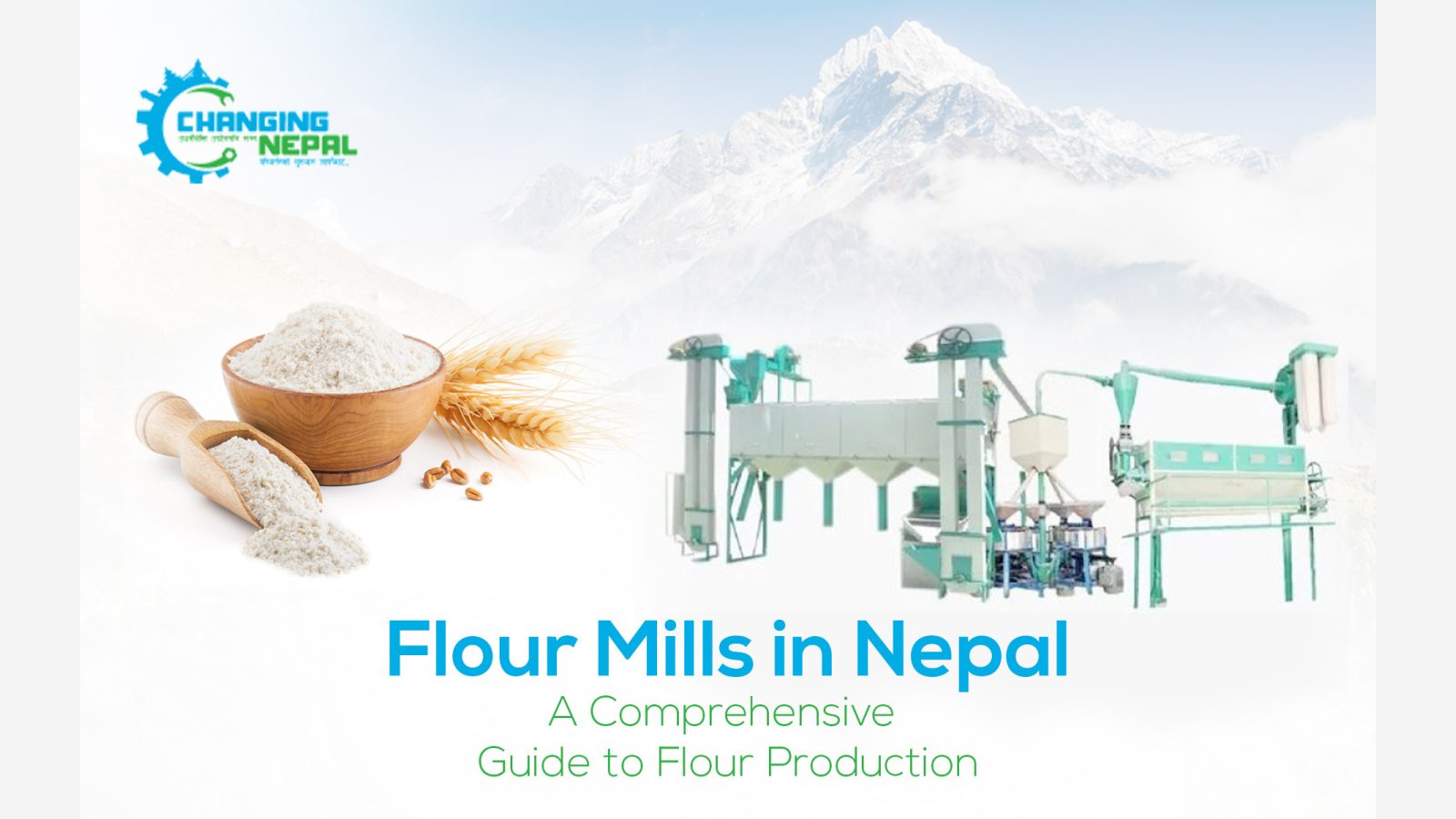
Flour mills play a pivotal role in human life. From traditional grinding stones to contemporary sophisticated machines, flour production has continuously evolved and expanded the horizons of the food industry.
Being Nepali, we mostly rely on bread for our meals whether it be breakfast, lunch, or dinner. Flour is the fundamental ingredient of bread and other countless culinary delights.
But, have you wondered how such ingredients get to the kitchen?
Well, let me clear this for you. Flour is derived from grains and is used for a variety of dishes including baked products, breads, crisp pizzas, and fluffy cakes. Flour mills are one of the essential equipment that serves as a vital machine for the household to the food industry.
The Milling Process- From Wheat to Flour
The milling process is a series is transformations of grains to flour. Here are some of the key steps for flour processing:
1. Cleaning
When the grain arrives at the mill. Before getting crushed the grains are cleaned. Impurities such as dirt, stones, and debris are removed, which eventually ensure the purity of the flour.
2. Tempering
Tempering involves adding moisture to wheat. This helps to soften the grains which makes the grain easier to mill and produce a finer flour.
3. Grinding
Grinding is the next most essential step involved in flour production. In this stage, the powerful rollers are used to crush and grind the grains into finer and finer particles.
4. Shifting
This is a quality control checkpoint of flour. Here the sieves separate the flour into different grades based on particle size.
5. Packaging
After the flour is ready, it is carefully packaged and shipped to retail stores and bakeries. The bags and sacks get to be consumed.
Flour for every occasion, What are the types?
There are unique characteristics and applications of flour. The market offers different types of flour each for their uses. Here are some of the common types of flour that are used in our daily life:
1. All-Purpose Flour
All-purpose flour is a protean flour that is used in a variety of baking goods such as bread, cookies, cakes, etc. It is made from a mixture of hard and soft wheat flour and has a protein content of about 8-11%. This flour is easily available in most of the grocery stores and is comparatively affordable.
2. Bread Flour
Because bread flour has a greater protein content- between 10 and 13 percent. It can generate strong gluten strands, which are necessary to produce chewy bread. You can use bread flour to make the yeast bread flour for pastry.
3. Pastry Flour
It has a low protein content and contains 8-9 % flour, which is meant for cookies and pasties. Pastry flour facilitates the formation of flaky pastries and soft dough. You can also make exquisite cakes at home using it as it has a fine texture.
4. Whole Wheat Flour
One kind of flour that is derived from the entire wheat kernel is whole wheat flour. It is a substitute for white flour due to its higher fiber, vitamins, and minerals which makes it a healthier option. You can enjoy this flour as it improves your health with these nutritious gains.
Flour Mill Machineries: Models of Aata Mills in Nepal
The market offers various types of flour mills, each with different characteristics and applications. Here are some of the major types of flour mills:
1. Stone Mills
Stone mills are flour mill machines, also known as buhr mills, which are the oldest and most traditional type of flour mill. Here, the grains are crumbled between two rotating stones. Among the stones, one of them is rotating and another is stationary. Stone mills produce a fine, stone-ground texture because of their natural stone minerals.
Features of Stone Mills
- Unique flour and texture
- Perseverance of grain nutrient
- Environmental friendly and sustainable
- Regular maintenance and stone dressing.
2. Roller Mills
Roller mills are the common type of mills in modern commercial flour production. There the flour is produced by employing a series of rollers that crush and grind the grains into flour.
Features of Roller Mills
- Highly efficient and consistent
- Useful for large-scale commercial production
- Finer flour grade
- Finer flour grade
3. Impact Mills
Impact mills are also known as hammer mills or attrition mills which are used to force grind into flour. The rotating hammers and plates are used to strike the grain and break it into finer particles. These mills are recognized for high-speed operation and the ability to handle a variety of grains.
Features of Impact Mills
- Efficient and simple to use
- Handle a wide range of grains
- Compact design
4. Colloidal Mills
Another name for colloidal mills is ball mills because this uses a rotating cylinder filled with grinding balls to pulverize grains into flour.
Features of colloidal mills
- Effective for soft grinding grains
- Finer flour grades
- Closed system design and less contamination
- Suitable for delicate products
5. Pulverizers
Pulverizers are flour mills that use high-speed air jets to grind grains into fine flour. Thus, it is called micronizers or jet mills.
Features of Pulverizers
- Ultra-fine flour grades
- Contact-free grinding prevents contamination
- Suitable for specialized application
6. Home Flour Mill Machineries
Home flour mill machineries are the smaller and more affordable versions of commercial flour mills. These mills are used for household purposes. These machines employ roller and impact mechanisms and present grinding options to produce different flour grades.
Features of Home Flour Mills
- Freshly ground flour
- Customizable flour grade
- Convenient for small-scale baking
How to choose the right flour mill?
Selecting the right one could require some special and careful consideration of your needs and preferences because of the vast array of flour mills that are available in the market. Well, let me make it easy for you. Here are some of the major factors to consider before getting a flour mill:
1. Volume of grains
Before, purchasing a flour mill you should consider evaluating your production needs and choose a mill that can handle the volume of grains you are planning to process.
2. Grade and texture
It is essential to select a mill that matches your desired flour grade for your application. Also, get a flour mill that is capable of producing the flour with the correct grade.
3. Type of Grain
Before getting a flour mill, you should consider which flour mill fits perfectly for the type of grain that you are planning to grind whether it is wheat, corn, or rice.
4. Application difficulty
Getting a flour mill that takes less downtime and effort will help you in the long run and reduce maintenance costs therefore opt for a mill that is easy to use and operate.
5. Safety features
While buying a flour mill you should prioritize a mill that includes features like overload protection and an emergency shut-off mechanism to ensure safe operation,
Conclusion
In the realm of household equipment, flour mills have contributed significantly. This machine has transformed local grains into a staple food that is filled with nutrition. From traditional stone mills to modern roller mills, flour mills have a pivotal role in food production. The application of such different flour mills is wide. As you understand the unique production capacity and availability of ranges, flour mills supply high-quality flour. Well, this just makes flour mills the secret ingredients of success. When are you getting flour mill machineries at your outlet?