
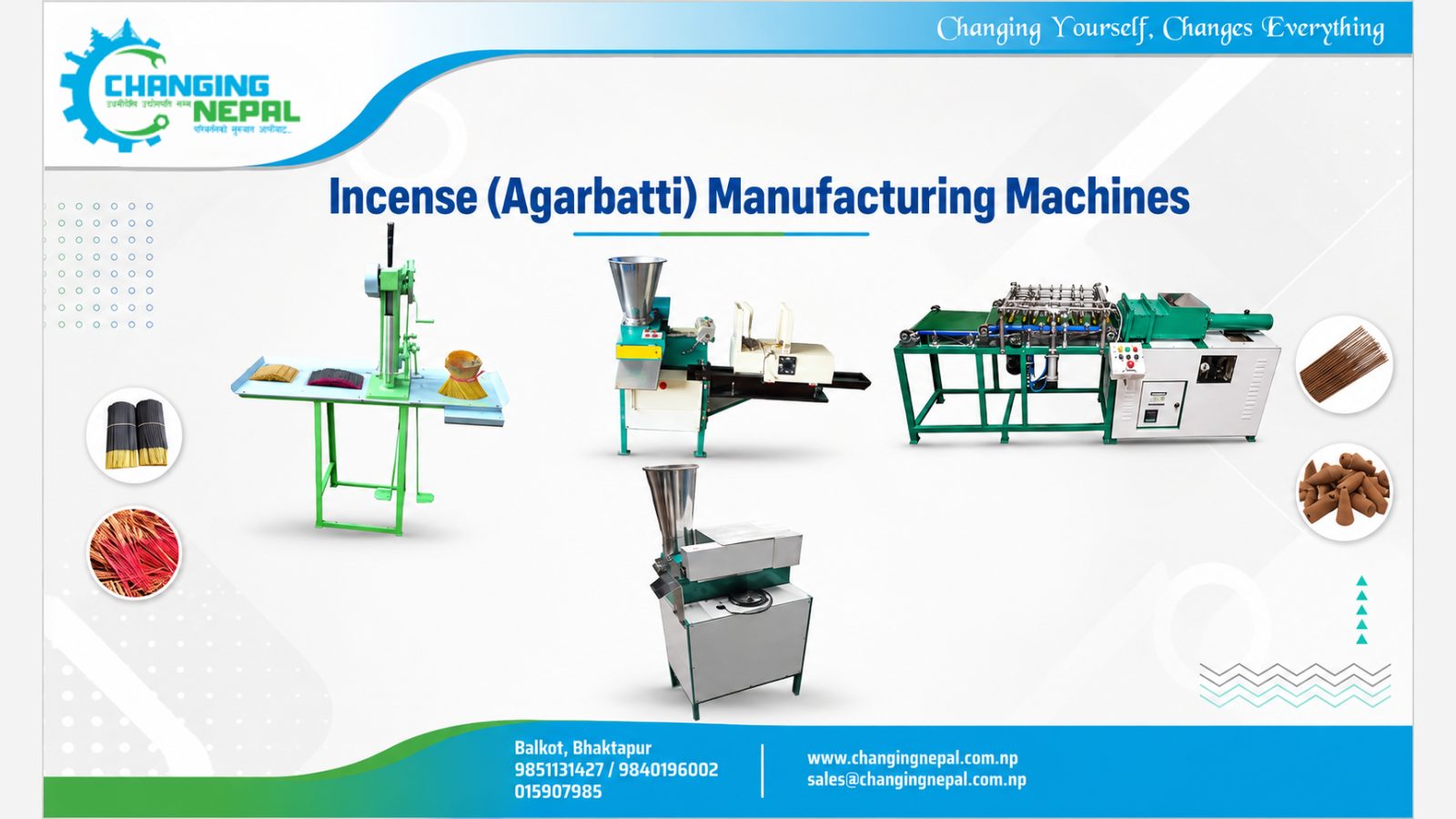
Agarbatti (Incense) refers to scented products that release an enchanting aroma when burnt. Incense products are deeply rooted in Nepali households, temples and daily rituals. Whether it is agarbatti (incense sticks), dhoop sticks or the newly emerging stickless variants like dhoop cup and samprani cup, their use in daily rituals, religious offerings and even meditation is ever-increasing. Unlike many seasonal industries, neither the raw materials nor the demand is affected by season or whether and only increases in festive season. This makes the Agarbatti Manufacturing Industry highly potent for new entrepreneurs in Nepal.
Another plus point for the Dhoop Industry is the local availability of raw materials. The materials like bamboo sticks, charcoal powder, jigat powder and perfumes required for agarbatti production can be sourced within Nepal. This helps keep the production costs low and supports the "Made in Nepal" campaign, reducing dependence on foreign countries for agarbatti products.
The agarbatti manufacturing industry offers excellent flexibility in terms of scale. A new and inexperienced entrepreneur can start small with an affordable pedal-operated machine, lower amounts of raw materials and small labor force but, a unique blend of aroma. Once a market for the unique blend is established, they can upgrade to a semi-automatic or fully-automatic agarbatti machine for medium to large scale production. Furthermore, a variety of products such as stickless stick agarbatti or cone agarbatti can be launched using dedicated machines. This property makes the incense production industry inviting and accessible to every entrepreneur from home-based small manufacturers to large-scale commercial producers.
This article discusses about the process of making stick core and stickless incense, agarbatti machines available in Nepal with their specs and prices and a comparison of various types of machines.
Section Links
- Incense (Agarbatti & Dhoop) Manufacturing Process
- Agarbatti & Dhoop Making Machines in Nepal
- Comparison Table
- Frequently Asked Questions
Incense (Agarbatti & Dhoop) Manufacturing Process
Incense products can be broadly classified into two categories:
- Stick core agarbatti: They are built around a bamboo stick core. The aromatic flammable components are coated around the bamboo stick.
- Stickless agarbatti: They have no bamboo core at all. They are shaped either as a cone/cup (like a dhoop cup or samprani cup) or as a plain stick (stickless dhoop stick).
The manufacturing process differs slightly depending on the type being produced.
Stick Incense (With Bamboo Core) Process
- Paste Preparation: An aromatic flammable paste is prepared by mixing jigat powder, charcoal powder, or other base materials with water to form a smooth, workable dough. The jigat powder acts as binder that binds the paste of aromatic materials together while the charcoal powder makes the mixture flammable.
- Bamboo Stick Feeding: Bamboo sticks are automatically fed into the agarbatti machine, which forms the base for the incense stick.
- Coating: The prepared paste is coated evenly around the bamboo stick using the machine's rolling mechanism. A small portion is left at the bottom to hold while lighting.
- Cutting to Length: The coated sticks are cut to the required standard length.
- Drying: The freshly rolled agarbatti sticks are naturally sun-dried or dried in a drying chamber to remove moisture.
- Packing: The dry sticks are dipped or sprayed with fragrance, and then packed for sale.
Stickless Incense (Dhoop) Process
Stickless dhoop does not use a bamboo core. They are shaped either as a cone/cup (samprani cup, dhoop cup) or as a plain stick, depending on the die fitted in the dhoop machine.
- Dough Preparation: A thick paste or dough is prepared from a mix of charcoal powder, sawdust, herbal or masala ingredients, and binding agents. The jigat powder acts as binder that binds the paste of aromatic materials together while the charcoal powder makes the mixture flammable.
- Shaping: The dough is fed into the dhoop cone machine or dhoop stick machine, where it is pressed through a die of the desired shape and diameter. Cone-shaped dies produce dhoop cups and samprani cups, while round dies produce plain stickless dhoop sticks.
- Cutting: An auto cutter cuts the extruded dhoop into pieces of the required length.
- Drying: The shaped dhoop cones or sticks are either sun dried or using a dehydrator.
- Packing: The dried dhoop cups/sticks are sorted and packed for distribution.
Agarbatti & Dhoop Making Machines Available in Nepal
Pedal Agarbatti Making Machine
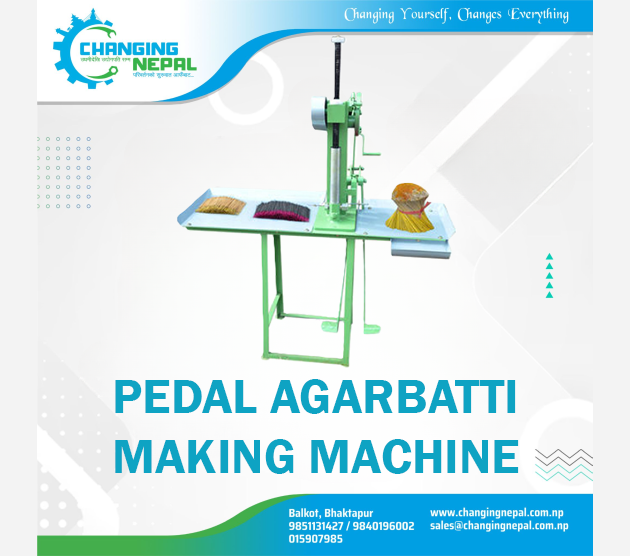
The Pedal Agarbatti Making Machine is a manual machine operated using a foot-pedal. It is suitable for entrepreneurs starting a small-scale incense manufacturing business. The machine is simple to operate, requires minimal maintenance, and is available in different models. The 80 and 90 models include an additional spare die set.
| Specification | Details |
|---|---|
| Operation | Manual Pedal Operated |
| Power Requirement | Not Required |
| Price | NPR 75,000 – 95,000 |
| Additional Feature | Extra spare die set with selected models |
View Pedal Agarbatti Making Machine Details
Fully Automatic Agarbatti Making Machine
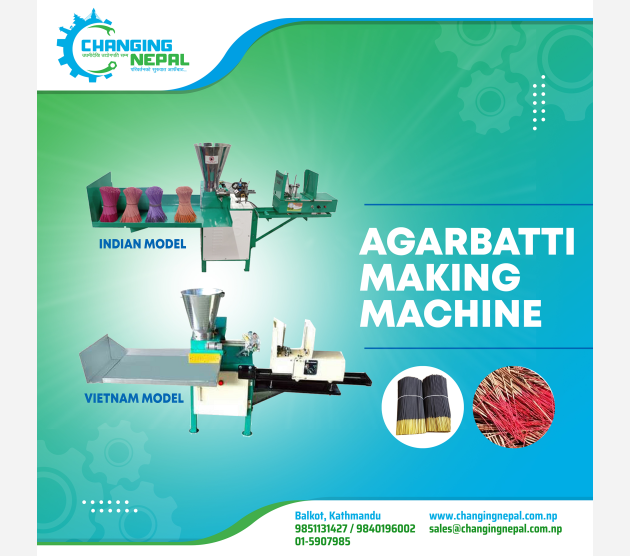
The Fully Automatic Agarbatti Making Machine is designed for continuous production of bamboo stick incense with minimal manual intervention. It automatically coats incense paste onto bamboo sticks, producing uniform-quality agarbatti at high speed.
It is suitable for medium to large-scale agarbatti production.
| Specification | Details |
|---|---|
| Production Capacity | 40–100 kg/day (depending on model) |
| Power | 1–1.5 HP (Approx. 2.5 kW) |
| Voltage | 220 V |
| Weight | 180–250 kg |
| Price Range | NPR 1,95,000 – 2,75,000 |
View Fully Automatic Agarbatti Making Machine Details
Dhoop Stick Making Machine (Nano Model)
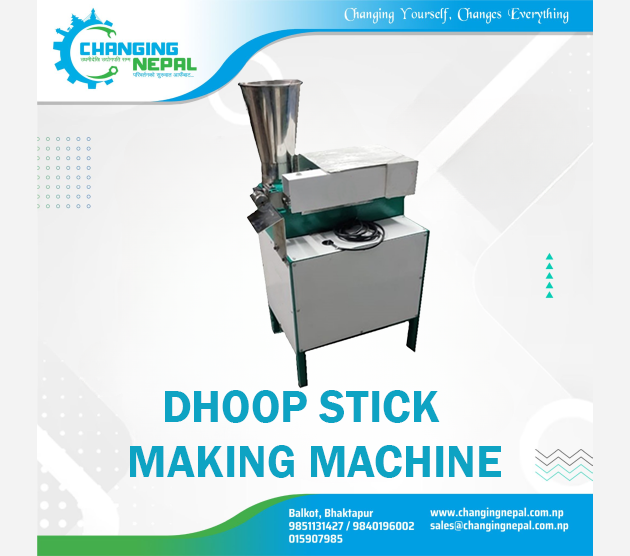
The Nano Dhoop Stick Making Machine produces stickless dhoop sticks in various diameters using interchangeable dies. The machine offers high-speed production with low power consumption and is suitable for manufacturing incense used for religious and commercial purposes. A conveyor system can be added as an optional accessory for improved productivity.
It is suitable for medium-scale stickless dhoop production.
| Specification | Details |
|---|---|
| Production | Up to 70,000 pieces/day (Approx. 150 kg/8 hrs) |
| Machine Speed | 200 pieces/min |
| Power | 1 HP |
| Weight | 96 kg |
| Price | NPR 1,85,000 |
View Nano Dhoop Stick Making Machine Details
Dhoop Stick Making Machine (Candy Type)
The Candy Type Dhoop Stick Making Machine is designed for producing thicker stickless dhoop sticks of various lengths and diameters. The machine supports interchangeable dies for different product sizes and offers stable production with optional conveyor support.
It is suitable for medium to large-scale stickless dhoop production.
| Specification | Details |
|---|---|
| Production | Up to 55,000 pieces/day (Approx. 150 kg/8 hrs) |
| Machine Speed | 120 pieces/min |
| Power | 1 HP |
| Weight | 150 kg |
| Price | NPR 2,75,000 |
Hydraulic Dhoop Stick Making Machine (With Auto Cutter)
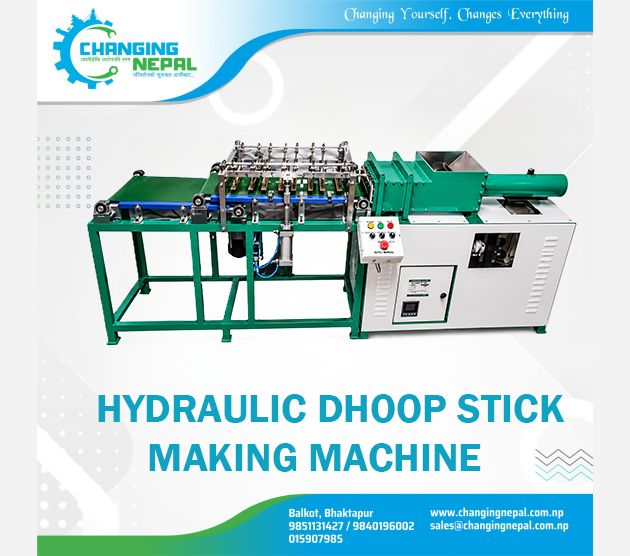
The Hydraulic Dhoop Stick Making Machine is a heavy-duty production machine equipped with an automatic cutter, dual conveyor system, hydraulic operating system, and variable speed control. It is capable of producing high volumes of stickless dhoop with consistent quality and requires minimal manual intervention.
It is suitable for large-scale stickless dhoop production.
| Specification | Details |
|---|---|
| Production Capacity | 150–250 kg/8 hrs |
| Power | 3.5 HP (3 Phase) |
| Weight | 420 kg |
| Conveyor | Dual Conveyor (Built-in) |
| Price | NPR 6,20,000 |
View Hydraulic Dhoop Stick Making Machine Details
Comparison Table
| Machine | Used For | Production | Power | Price (NPR) |
|---|---|---|---|---|
| Pedal Agarbatti Machine | Bamboo Stick Agarbatti | Manual | Not Required | 75,000–95,000 |
| Fully Automatic Agarbatti Machine | Bamboo Stick Agarbatti | 40–100 kg/day | 1–1.5 HP | 1,95,000–2,75,000 |
| Nano Dhoop Stick Machine | Stickless Agarbatti | 70,000 pcs/day | 1 HP | 1,85,000 |
| Candy Type Dhoop Machine | Stickless Agarbatti | 55,000 pcs/day | 1 HP | 2,75,000 |
| Hydraulic Dhoop Machine | Stickless Agarbatti | 150–250 kg/8 hrs | 3.5 HP | 6,20,000 |
Frequently Asked Questions (FAQ)
1. Which agarbatti machine is suitable for beginners or small-scale business?
The Pedal Agarbatti Making Machine is a good choice for new entrepreneurs starting with limited space and budget. It does not require electricity, is easy to operate, and is suitable for home-based or small-scale production.
2. Which machine is suitable for medium-scale incense production?
The Fully Automatic Agarbatti Making Machine and the Nano Dhoop Stick Making Machine are good options for businesses looking to increase production capacity. These machines provide higher production output with consistent product quality while requiring minimal manual operation.
3. Which machine is suitable for large-scale commercial production?
For large-scale manufacturing units, the Hydraulic Dhoop Stick Making Machine is the most suitable option. Its hydraulic operating system, automatic cutter, built-in conveyor system, and high production capacity make it ideal for continuous heavy-duty operation and production.
4. What types and sizes of incense products can these machines manufacture?
Different machines are required for stick and stickless incense production. For stickless incense, depending on the machines and die used, stickless dhoop sticks, cone incense, sambrani (samprani) cups, and dhoop cups can be produced. Different die sizes are available to produce incense sticks of various diameters and lengths, and additional dies can be purchased separately whenever required.
5. What raw materials are required for incense manufacturing?
The primary raw materials include bamboo sticks (for agarbatti), charcoal powder, jigat powder, wood powder or sawdust, fragrance oils, water, and packaging materials. These raw materials are readily available in Nepal. We can also provide the contact details of reliable raw material suppliers to help customers get started.
6. Do you provide training and after-sales support?
Yes. Depending on the machine model, training on machine operation and general maintenance is provided. For selected machines, guidance on raw material mixing formulas and supplier contacts is also available, helping customers begin production with confidence.