
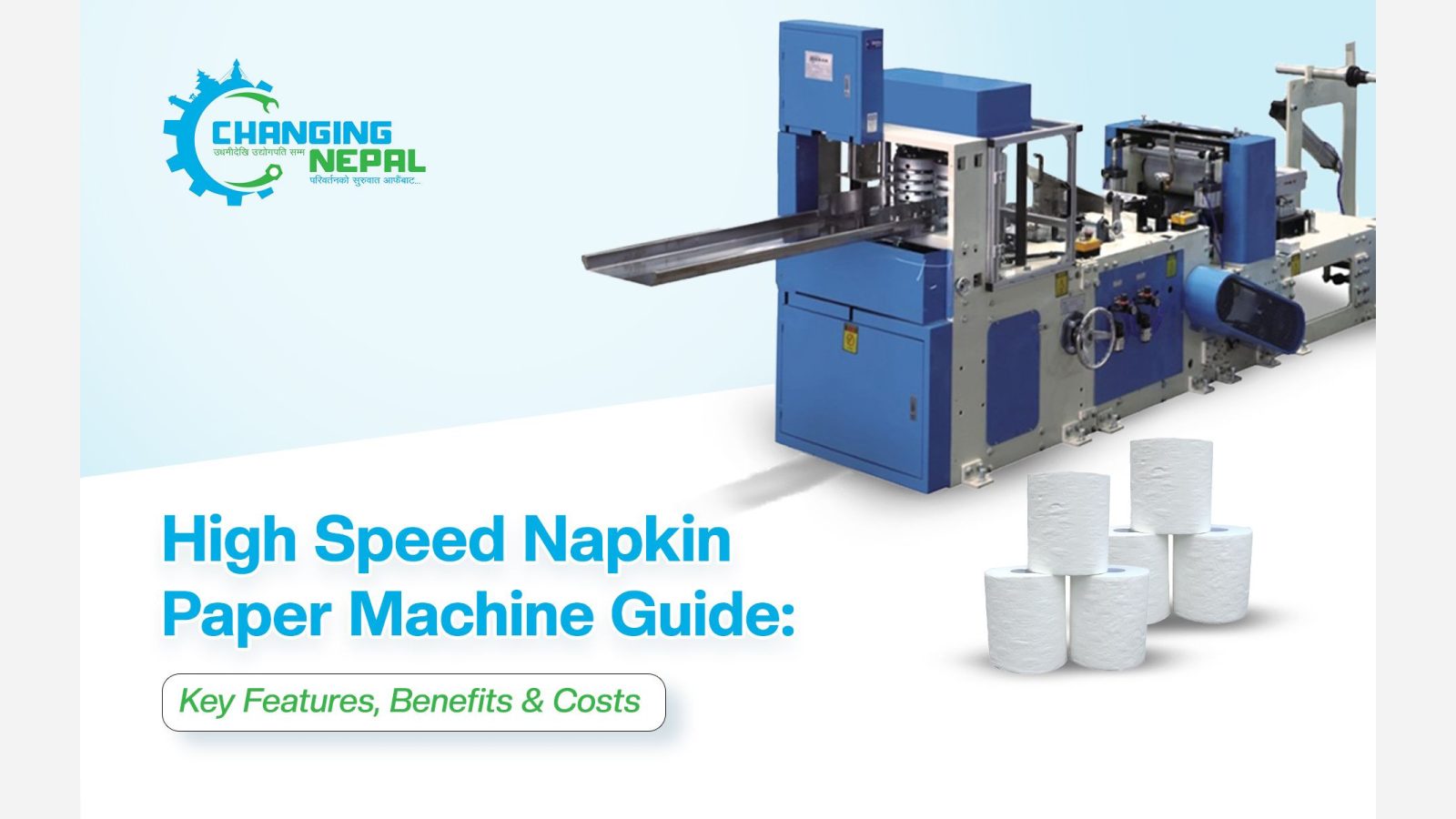
A high-speed napkin paper machine is an important long-term investment for businesses producing napkins and other tissue products, especially if those businesses wish to achieve efficiency, quality, and volume. In Nepal, where the demand for hygienic paper products is increasing quickly, being familiar with the specifications, price, and advantages of a high speed napkin paper machine should help entrepreneurs make a rational investment decision. This writing attempts to give an in-depth overview of the features, specifications, and prices associated with the 230 mm high speed napkin paper machine for the Nepalese market.
Overview of the High Speed Napkin Paper Machine
The model that is presented here is a high speed napkin machine that has a host design speed optimally ranging from 800-1000 sheets per minute per unit. Designed for a conventional paper width of 230mm, this machine will allow the user to achieve napkin production at high speed without compromising product quality.
- Design speed: 800 sheets/minute/set
- Production speed: approximately 700 sheets/minute/set
- Conventional paper width: 230 mm
- Folding size: 115mm × 115±2 mm (1/4 fold)
- Raw paper weight: recommended wood pulp paper of 13-23 g/m², typically 2-3 layers
- Original paper diameter: maximum 1200 mm, while the back shelf base has a maximum of 1350 mm
These capabilities make it entirely workable for all producers involved in conventional paper to achieve high outputs with consistent quality.
Technical Specifications and Features
The machine has several important technical specifications and features that improve performance and make operation easier:
1. Drive and Transmission:
- This machine employs a synchronous belt and gear mechanism to allow the transmission to run smoothly.
- The triangle belt transmission and 2.2 KW motor power offer good stability when operating.
- This machine requires a three-phase 380V, 50Hz power supply to consume energy more efficiently.
2. Paper Feeding and Cutting:
- The paper feeding process is driven by a synchronous belt drive, and the auxiliary support is a baseband.
- The paper cutting is conducted with a high-precision Japanese-imported circular band saw blade (3200 mm), adjustable in tension and tilt, which maintains the cutting quality.
- The paper feeding rollers have a fixed gap. In contrast, the folding roller gap is adjustable to account for different paper thickness and folds.
3. Control and Safety Systems:
- The variable frequency speed regulation feature will aid the user in optimizing the operating speed and enable a reduction in wear.
- The machine has a paper breakage detection system that will decelerate and stop the machine when materials are depleted, reducing waste.
- All major parts of the transmission feature protective covers to ensure worker safety and the operational life of the machine.
4. Compressed Air:
- In order to operate, the machine requires a compressed air supply of 0.5 MPa or higher, and it will consume 5 m³/min of dry, clean air. Therefore, the buyer will have to provide the air compressor.
- Pneumatic-assisted delivery of the paper ensures that the finished products transfer smoothly.
5. Dimensions and Weight:
- Physical size: 3.7 m (L) x 1.6 m (W) x 1.7 m (H)
- Weight: Approximately 1 ton per unit, so it fits nicely in a medium-sized factory.
6. Miscellaneous:
- The band saw blade can be sharpened both manually and automatically. This last piece is important since it helps maintain the precision of the blade.
- The paper slots are stainless steel, so the paper is constantly in a durable and hygienic state.
- The paper is adjusted by screws, allowing fine-tuned adjustment to help with product quality.
Comprehensive Spec Table of 230mm High Speed Napkin Paper Machine
|
Feature |
Specification |
|---|---|
|
Design Speed |
800 - 1000 sheets/min/unit |
|
Production Speed |
~700 sheets/min/unit |
|
Conventional Paper Width |
230 mm |
|
Raw Paper Weight |
13 - 23 g/m² (wood pulp paper) |
|
Paper Thickness Layers |
2 - 3 layers (Minimum 18g single layer) |
|
Original Paper Diameter |
≤ 1200 mm (Max 1350 mm back shelf) |
|
Finished Product Size |
230 mm × 230 ± 2 mm |
|
1/4 Fold Size |
115 mm × 115 ± 2 mm |
|
Drive Mode |
Synchronous belt, gear |
|
Paper Feeding Belt |
Synchronous belt drive |
|
Paper Cutting Method |
Circular band saw blade (3200mm, Japan imported) |
|
Band Saw Blade Adjustment |
Adjustable tension & tilt angle |
|
Motor Power (Main) |
2.2 KW |
|
Control Mode |
Variable frequency speed regulation |
|
Paper Breakage Detection |
Equipped with detection & auto shutdown |
|
Power Requirements |
Three-phase 380 V, 50 Hz |
|
Compressed Air Pressure |
≥ 0.5 MPa (self-provided) |
|
Compressed Air Consumption |
≥ 5 m³/min (dry, clean air) |
|
Machine Dimensions (LxWxH) |
3.7m × 1.6m × 1.7m |
|
Machine Weight |
About 1 ton per unit |
|
Safety Protection |
Protective covers on the transmission |
|
Paper Delivery Method |
Pneumatic assistance, sheet-to-tape feeding |
|
Estimated Cost (Nepal) |
NPR 13 Lakh (single phase: NPR 13.3 Lakh) |
Key Benefits of High-Speed Napkin Machines in Nepal
For manufacturers in Nepal, buying a high-speed napkin machine will have numerous important benefits:
- High Production: Operating at speeds of up to 1000 sentences/min, the machine will allow for a much higher production capacity through periods of demand peaks.
- Quality: Uniform sheet sizes, through a constant folding and consistent cut, will determine the aesthetics of manufactured napkins that have a critical value to a brand and customers' perception.
- Employee Safety: With safety features and protective devices in place, the possibilities of workplace accidents and machine downtime will be significantly reduced.
- Reduction of wastage of material: Paper breakage detection on the napkin machine, reducing wastage of material, making manufacturing napkins cheaper and sustainable, which is an important issue for Nepal, considering the newness of the industrial space.
- Versatility: Capable of handling 2-3 ply paper in terms of wood pulp paper weight of 13-23g/m²; the napkin machine is suitable for handling and producing various qualities of napkins, whether regular or higher quality products.
- Energy Efficient: The variable frequency to regulate speed; the amount of motor energy used is reasonable, making the cost statistics of energy.
Cost Considerations in Nepal
In Nepal, the cost of the high-speed napkin paper machine is critical to Nepalese investors, particularly with the factory being a small-scale local production and market demand.
- Machine Cost: NPR 13 lakh approx purchase price for a standard three-phase 380V machine type.
- Single-phase version, which is slightly more expensive at NPR 13.3 lakh, can service small factories without three-phase power available on site.
- Additional Equipment: The machine will need to be purchased separately, which is an air compressor, which adds to the capital expenditure of the start-up costs. As a rule, compressed air must meet certain pressure and quality to run the machine effectively.
- Installation and Maintenance - When setting up the factory, the proper infrastructure should be put in place. The air compressor should also be installed. Machine maintenance includes sharpening or replacing band saw blades, lubrication of moving parts such as chains, drives, wheels, etc., and regular health and safety checks on machine operation and working environment.
While looking at the potential volume and savings in labour and downtime against the original cost of investment, the payback should be achievable in a reasonable timeframe.
Practical Advice and Tips for Nepalese Businesses
In the context of the foreign industrial environment in Nepal, the following points are recommended:
- Raw Material Choice: Use wood pulp grades of paper between 13 to 23 g/m² to optimize performance. If the raw material can be sourced locally, or even from neighbouring India, it will add to raw material savings.
- Power Supply: If you have a three-phase power connection, use it -- it improves machinery efficiency and longevity. Single-phase arrangements can be made, but are second-best options when larger quantities are being produced.
- Air Compressor: When selecting compressors, ensure they meet or exceed 0.5 MPa specifications and flow rates of 5 cubic meters per minute of dry air. Be sure to test the quality of the air regularly to prevent machinery from wearing out.
- Operator Education & Training: The operator should be trained to adjust the folding roller gaps, feed paper into the machine efficiently, catch when paper breaks and other issues arise, and perhaps gain familiarity with safely sharpening their own cutting blades.
- Safety Items: Look for and agree to factory safety items as per best practices. At a bare minimum, ensure things are close to being safe, such as fitting safe covers for transmission parts and wiring according to electrical standards.
Recommended Local Supplier: Changing Nepal
For companies in Nepal that need a trustworthy source for supply and service, Changing Nepal is the leading supplier of high-speed napkin paper machines. Changing Nepal is located in Kathmandu and Biratnagar. They are experts in food and machine equipment and provide:
- On-site installation and production training;
- Technical support and service maintenance;
- Spare parts;
- User required solutions.
Contact information for Changing Nepal:
Location: Anantalingeshwar, Kathmandu 44600
Phone: +977 985-1131427
Hours of operation: 10 AM - 5 PM (Mon-Fri)
Market Potential and Future Prospects in Nepal
The demand for partially finished and finished tissues and napkins is growing due to the increase in Nepal's economy, population, hygiene awareness, and tourism industry. Increased local production, as opposed to imports, using fast-speed napkin paper machines, will lessen reliance on exports and help save foreign dollars.
- The hospitality and healthcare sectors are growing and represent consistent demand.
- Government incentives for installing new equipment will assist in overcoming the initial costs to implement more modern machines.
- The opportunity to expand product packaging and branding before exporting to neighboring countries.
Conclusion
For Nepalese suppliers looking to manufacture tissue papers and napkins, the 230mm high-speed napkin paper machine offers a good balance between modern technology, efficiency, and the cost of the machinery. By considering many of the key benefits of the machine, including superior printing and production speeds, precision in cutting, safety systems, and paper of the right characteristics, individual suppliers can scale their operations, improve the consistency of their products, and improve profitability. The price of the machine and cost of operation are warranted, and should be of special interest to medium and large manufacturers in Nepal.