
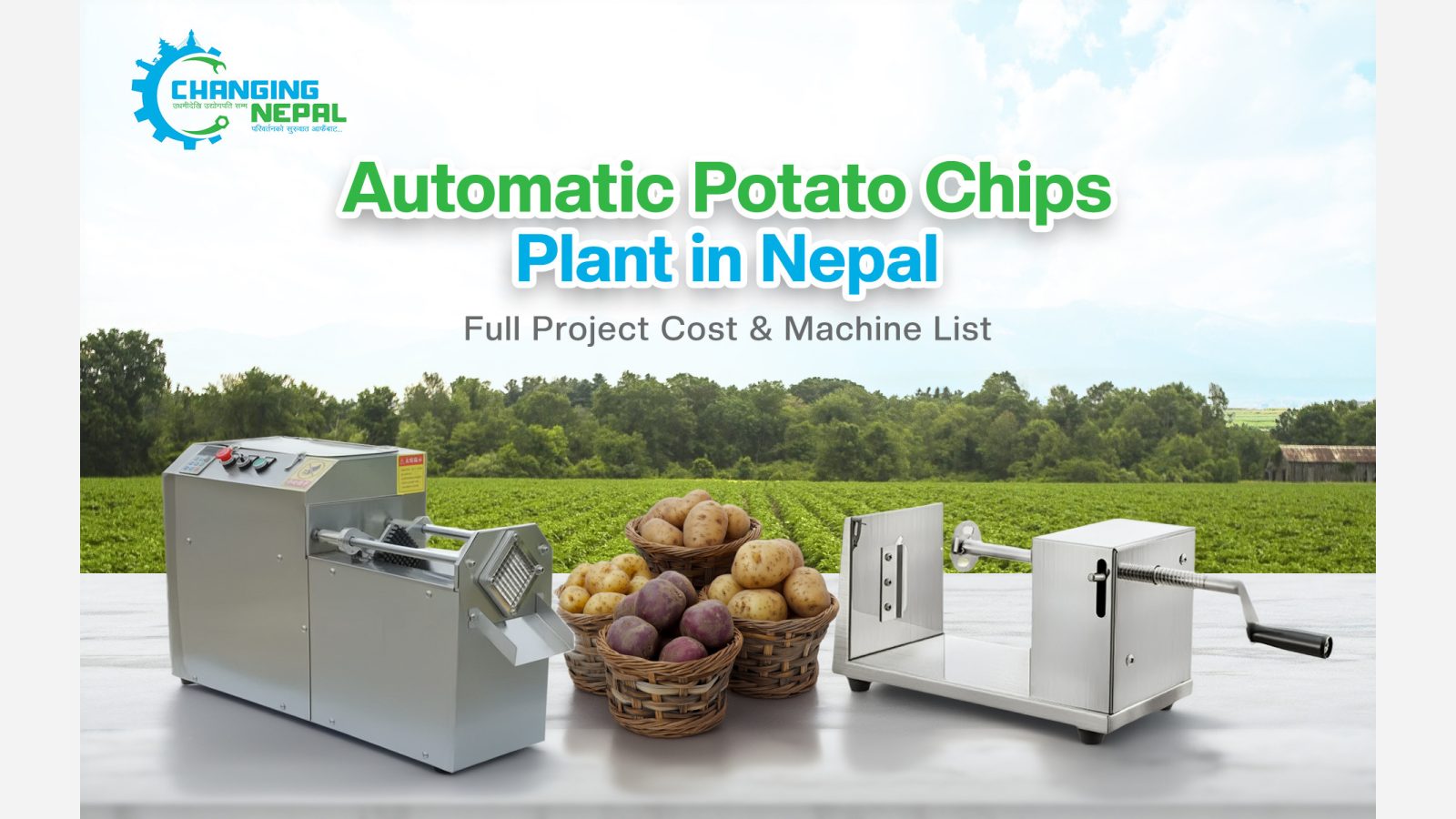
The market of packaged snacks, particularly the potato chips, is expanding at a very high rate in Nepal. Potato chips have become one of the most popular snack items among all age groups since there are small grocery shops up to supermarkets. This rising need has provided a good opportunity for entrepreneurs to venture into a potato chips manufacturing company.
The use of an automatic plant that produces potato chips assists in the production as compared to manual or semi-automatic systems. This renders them appropriate in medium and large-scale snack companies.
In this article, the overall project cost and the final list of machines needed to establish a company that would produce automatic potato chips in Nepal will be explained. This guide will assist you in learning about the investment, equipment, and minor requirements for your business in manufacturing chips.
What Is an Automatic Potato Chips Plant?
A fully automated potato chips plant is an entire production facility that handles raw potatoes to produce ready-to-pack potato chips with little human intervention. Machines are used to carry out all the significant processes like washing, peeling, slicing, frying, seasoning, and packing of food in a continuous and systematic manner.
When compared with small manual units, an automatic plant is guaranteed to provide consistent chip thickness, uniform taste, increased hygiene, and increased output. The machines are to operate cooperatively to minimise human error and accelerate production.
The commercial snack production plants are usually occupied by the companies that desire to manufacture the products (potato chips) in large quantities and supply them to the local markets, supermarkets, and distributors within Nepal. Automatic plants are perfect in any business that seeks to build a brand and achieve long-term growth.
“ Related Products: Tomato Ketchup Making Machine”
Why Start a Potato Chips Plant in Nepal?
The proposed business in Nepal has a good potential to set up a potato chips plant because of the increasing need in the packaged snacks. Potato chips are extensively eaten by both the young and the elderly, their demand has been on the rise both in the urban and rural regions.
The supply of raw potatoes in Nepal is good, and this will make the price of raw materials lower and contribute to stability in the supply. Locally prepared chips can be priced competitively as they retain their freshness and quality as compared to imported snacks.
The snack food market in Nepal continues to grow, and there is still space to introduce new brands in the market and serve them. An automatic plant of potato chips allows the businesses to make large volumes with the same flavour and level of cleanliness, which is simpler to distribute to stores, supermarkets, and distributors. This makes the potato chips business a good long-term profit and growth choice.
Project Cost Breakdown (Estimated for 2026)
To establish an automatic plant of potato chips in Nepal, first need to be required to invest in space, machines, utilities and daily operations. All the costs of the project are based on the level of automation and production capacity, though here is a rough breakdown of the costs to get your plans off.
1. Land and Space Requirements
You must have enough room for machines, storage, packing, and movement. The price will be cheaper in case you have already landed. Otherwise, renting or constructing a small industrial area will become an addition to the budget.
2. Building & Infrastructure
This involves flooring and drainage, ventilation, supply of water and simple electrical installation. An environment that is clean and food-safe is relevant to snack production.
3. Machinery and Equipment Cost
The largest example of investment in an automatic potato chips plant is the machinery. This is the highest percentage in the overall budget, depending on the capacity and quality of the machines.
4. Raw Materials & Working Capital
An initial stock of potatoes, cooking oil, seasoning, packing materials and cash to run the day-to-day operations will be required.
5. Electricity and Utilities
Auto plants use more power, particularly fryers, slicers and packing machines. Power backup systems can also be needed.
6. Staffing and Labour Cost
The smooth work in an automatic plant requires the presence of operations, helpers, and supervisors.
7. Miscellaneous Costs
This consists of transportation, installation, trial, licenses and surprises.
Machine List for Automatic Potato Chips Plant
The automatic potato chips plant involves a machine assembly that reacts sequentially to turn the raw potatoes into ready-made packaged chips. The standard machine listing to implement a seamless flowing process of production is provided below:
1. Potato Washing & Peeling Machine
The machine is used to clean and remove dirt and skin from the raw potatoes. It is time-saving and cleans potatoes prior to slicing.
2. Potato Slicer Machine
The slicer cuts potatoes into uniform slices of thinness. Slicing uniformly is significant to uniform frying and good flavour.
3. Blanching Machine
Blanching eliminates starchy potato slices and enhances the colour and texture. It also assists in the reduction of oil uptake in the frying process.
4. Dehydrator / Dryer
This dehydrator machine is used to dry the potato slices prior to frying. It enhances the quality of frying and decreases the use of oil.
5. Automatic Fryer Machine
The fryer is used to cook the potato slices using hot oil. Automatic fryers regulate the temperature and time taken to fry to achieve quality.
6. Oil Filtration System
This system is a filtration system that removes food particles and used oil. Clean oil enhances the flavour and duration of the oil.
7. Flavouring / Seasoning Machine
Using this machine, chips are fried, and spices and flavours are mixed evenly.
8. Automatic Packing Machine
The chips are sealed in packets by the packing machine and remain fresh and hygienic. It is also used to package faster to supply to the market.
Production Capacity & Output
The manufacturing capacity of a production plant of automatic potato chips will be determined by the form of machines used, the degree of automation, and the number of hours worked. Nepal's small to medium-sized auto plants typically manufacture 50kg to 200kg of finished chips in an hour.
The plant operates on a continuous basis, and it can manufacture a large number of chips to serve local markets and distributors, as the plant operates 8 to 10 hours a day. Plants with higher capacity are able to work extended hours and satisfy the high-volume demand.
Automatic machines mean that slicing, frying and seasoning are done with uniformity and control to add to the quality will assist the businesses to respond to the demand in the market and enhance their profitability.
Profitability & Expected Returns
A profitable business in Nepal can be an automatic plant of potato chips if it is managed well. Profit is largely reliant on production capacity, cost of raw material, selling price and market coverage. As the potatoes are locally available, the cost of the raw materials is also stable.
The profit margin in the manufacture of potato chips may vary between 20 and 35 on average, depending on the branding, packaging and distribution. Automatic plants also save the labor cost and wastage, which contributes to profit maximisation.
Most small to medium plants can break even in 2-3 years with regular production and high demand in the market. Delivery into the local shops, supermarkets and distributors can also enhance the sales volume and returns.
How to Choose the Right Machines?
Selecting appropriate machines will ensure that there is effective running of the potato chips plant and success in the long run. The first thing you need to do is to determine what quantity you want to produce daily and then choose the machines that will accommodate your output. Low capacity of the buying machines may restrict the growth, whereas excess capacity may result in unjustified expenses.
Concentrate on the quality, material, and durability of the machines. Stainless steel machines that are recommended are those of food grade because they are hygienic, resistant to rust and are easy to clean. Make sure that the machines have automatic temperature control, even slicing, and smooth operation.
Licenses & Legal Requirements in Nepal
To operate within the confines of the law and safely, some licenses and legal requirements would have to be adhered to in order to start an automatic potato chips plant in Nepal. Here’s a simple overview:
1. Business Registration
You should open your company or enterprising in the office of the company Registrar (OCR) or as a small business in the local municipality.
2. Food License
To be able to legally produce and sell packaged snacks, a food production license is obtained from the Department of Food Technology and Quality Control (DFTQC).
3. VAT Registration
In case you have turnover that is above the government threshold, then you need to register Value Added Tax (VAT) with the Inland Revenue Department.
4. Health & Safety Compliance
Make sure that your plant meets the health and safety requirements, such as clean production zones, waste management, and safety measures among employees.
5. Local Permits
You may also require municipal permissions to operate your industry, to connect to electricity and water, depending on where you are located.
Maintenance & Safety Tips
To ensure the efficient running of an automatic potato chips plant, proper maintenance and safety measures are necessary. Proper maintenance would help in ensuring machines operate efficiently, limit the breakdowns and increase their life span.
Daily Maintenance:
- Wipe down all machines, mainly slicers, fryers and packing stations after every production cycle.
- Wipe out oil residues, potato scraps and food particles to keep the place clean.
Periodic Maintenance:
- Sharpen blades, lubricate running components, and examine motors and belts.
- It is best to get new ones to prevent delays in production.
Safety Tips:
- Wear safety guards and obey the operating instructions of each machine.
- Train crew on how to handle emergency stops and how to operate safely..
- To avoid accidents, keep the area of the plant dry, clean and well-ventilated.
Transform your vision into reality! Contact us at Changing Nepal for expert guidance, support, and solutions tailored to help you establish a successful automatic potato chips plant.
Get in Touch Now and take the first step towards a profitable business venture in Nepal’s thriving snack market!
Conclusion
The establishment of an automatic plant of potato chips in Nepal is a lucrative business venture since there is an increasing demand for packaged products. One can manufacture high quality of the chips with proper planning, use of the right machines, and legal laws that will allow you to satisfy the market demand.
Frequently Asked Questions (FAQ)
1. What machines are required for a potato chip plant?
The important machineries are the potato washing and peeling machine, slicer, blanching machine, fryer, oil filtration system, seasoning machine, and packing machine. Additional machines are optional, such as dehydrators to ensure better frying.
2. What is the daily production capacity?
Depending on the size of the machine used and the amount of workflow, small to medium automatic plants are capable of providing 50kg to 200kg of finished chips in an hour.
3. Is it profitable to start a potato chips business in Nepal?
Yes, it is possible to achieve 20-35% of profits and investment is recovered within 2-3 years, with proper planning and consistent quality, the potato chips business can bring good profit.
4. Do I need licenses to operate a chip plant?
Yes, to conduct business in Nepal, you must have registration of your business, a food production license, VAT registration (where required), and local municipality permissions.