
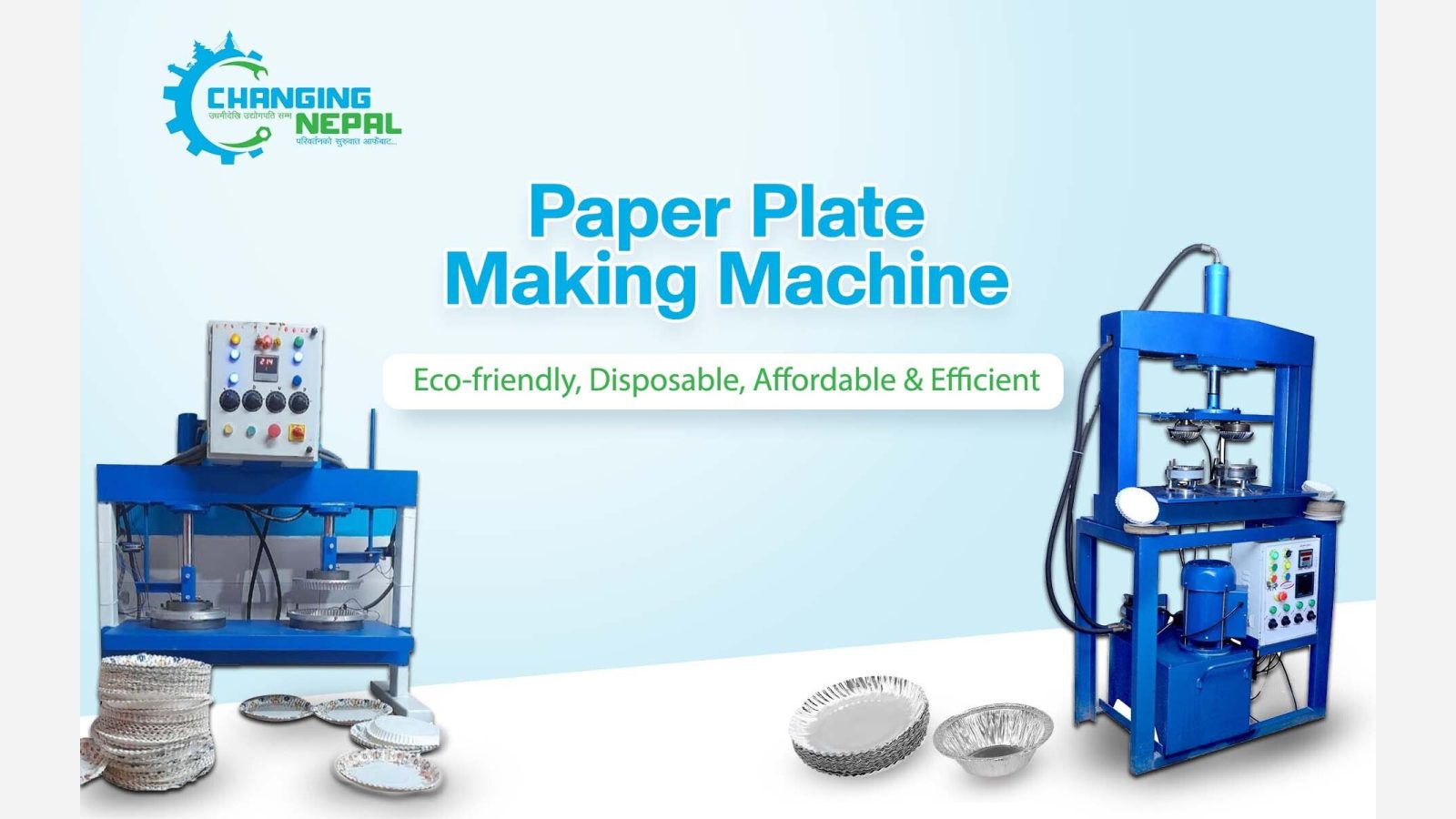
In today’s world, where environmental sustainability and business profitability go hand in hand, starting a paper plate manufacturing business is an increasingly popular and strategic choice. At present, the demand for eco-friendly tableware in Nepal is very high. From the fast-paced momo stalls in Kathmandu to grand wedding banquets in Pokhara, paper plates are slowly but surely being accepted as a feasible alternative to plastic and foam alternatives, as they are biodegradable and easy to dispose of. This transition has been aided not only by the increasing awareness of the environment but also by government-level initiatives and community campaigns to curb single-use plastics.
For an entrepreneur, this change presents not just a moral obligation but also an opportunity for profit. The paper plate-making industry is one of the most promising industries today, with high production capacity, low startup costs, and opportunities to scale on demand. The latest machines enable the production of thousands of strong biodegradable plates per hour to meet market demands and to create an environmentally friendly solution.
In Nepal, Change In Nepal Pvt. Ltd. has been a reliable partner to aspiring manufacturers. Stressing a lot on the empowerment of youth and women, they are offering a full gamut of manual crank machine models along with fully automated high-speed machines with installation and training, plus after-sales support. One good choice of a paper plate-making machine ensures the entrepreneur in keeping operational costs low, offering constant product quality, and retaining presence in the booming eco-friendly tableware market..
Understanding Paper Plate Manufacturing Technology
The Evolution of Paper Plate Production
Paper plate production has evolved from a simple manual process to top-grade automated systems capable of producing high-quality disposable tableware in huge quantities per hour. The core of manufacturing involves the following processes: sourcing sustainable raw materials, shaping and forming plates with the help of specialized machinery, and manually applying them with food-grade coatings to enhance durability.
Raw materials used in the production of paper plates primarily comprise wood pulp, recycled paper, and biodegradable materials like bagasse (sugarcane fiber) and bamboo fibers, chosen for their strength, flexibility, and most importantly, their environmental friendliness. In modern times, most manufacturers prefer supply-grade unbleached paper pulp to minimize the use of chemicals and impact on the environment.
For the forming and shaping processes, specialized molds and industrial die-cutting machines are used to maintain efficiency and uniformity. Here, pressing operations are carried on to remove the excess water and achieve thickness and consistency. The drying from heated rollers or air drying maintains the structure of the newly formed plates
Why Paper Plate Making Machines Are Trending in Nepal
Several factors have contributed to the booming popularity of paper plate manufacturing in Nepal:
- Environmental Concerns – Biohazardous plastic waste is a growing problem. According to the Nepal Solid Waste Management Baseline Study, a huge share of landfill waste is caused by single-use plastics. Paper plates, being biodegradable, help to mitigate environmental impacts.
- Government Push Against Plastics – Municipalities like Kathmandu Metropolitan City have already taken steps to ban certain categories of plastic packaging. This gives a chance for any eco-friendly alternatives, like paper tableware.
- Growing Demand in the Food Industry – Plates that are disposable have gained a lot of popularity among street vendors, caterers, and event organizers because of convenience. From panipuri stalls to festival catering, the demand is constant and diverse.
- Low Entry Barriers for Entrepreneurs – With machines costing approximately NPR 1,15,000, a small entrepreneur can start production within weeks.
Manufacturing Process Breakdown
The systematic approach adopted by the paper plate manufacturing process guarantees consistent quality and efficiency:
- Raw Material Preparation: Large rolls of paper are fed into the manufacturing machines, where continuous sheets of paper are prepared for cutting and shaping.
- Die Cutting and Shaping: Industrial die-cutting machines exert tremendous pressure to cut through very sharp-edged dies to form the desired plate sizes. The paper is thereafter moulded to its final three-dimensional shape through either hydraulic or pneumatic pressure systems.
- Quality Control: Rigorous tests are performed to determine that finished goods comply with industry specifications, including testing for pulp consistency, sheet formation, moisture content, and structural stability.
- Packaging and Storage: The plates produced are carefully stacked, packaged, and stored in readiness for distribution per quality maintenance procedures along the supply chain.
Sustainable Paper Plate Manufacturing: Profits with Purpose
Modern paper plate machines enable the manufacturers to use sustainable raw materials like:
- Food-grade paper rolls
- Saal leaves for traditional, sturdy plates
- Recycled paper blends
By buying eco-friendly inputs, one not only cuts the waste going into landfills but also taps into a growing market of consumers willing to pay an extra amount for anything that is proclaimed to be a green product.. Companies such as Change In Nepal Pvt. Ltd is working toward the promotion of environmental sustainability in manufacturing by providing a machine for both paper and natural leaf plate production.
A hydraulic model from Change In Nepal can make standard paper plates and saal leaf thalis, which makes your business very versatile and adaptive to different markets.
Traditional vs. Modern Manufacturing
The rich heritage of biodegradable tableware manufacture in Nepal provides an unparalleled platform to create a history for paper plate making. Tapari and duna made of sal leaves have been used since time immemorial to emphasize Nepal's commitment toward sustainable dining. Apart from their cultural implications, environmentally friendly means were never very good in terms of production capacity and market.
Modern paper plate manufacturing machines fill the gap by combining traditional environmental consciousness with modern production efficiency. After all, whereas manual tapari production of tapari may yield a few hundred pieces per day, modern paper plate machines manufacture thousands of plates per hour, rendering the commercial-scale production without compromising on the ecological merits of biodegradable products.
Types of Paper Plate Making Machines in Nepal
When you are about to start your paper plate business, choosing a machine that fits the quantity and type of production you want to make, your budget, and the space available, is a primary concern.
1. Single Mold Crank Paper Plate Machine
Good for beginners, this machine produces 4-inch to 12-inch plates with a speed varying from 900 to 1200 pieces/hour. It would be a good option for a small catering contract or supplying local vendors.
- Price: NPR 1,15,000 (includes one die size of your choice from 4–6 inches)
Best For: Startups and small enterprises that require a less costly entry-level machine.
2. Double Mold Crank Paper Plate Machine
One step beyond a single mold, this model can simultaneously produce two different sizes of plates, thereby increasing productivity
- Size Range: 4–12 inches
- Price: NPR 1,85,000
Best For: Businesses needing multiple size options for diverse clients
3. Hydraulic Paper Plate Machine
Hydraulic Paper Plate Machines cater to the paper and saal leaf plates and are available in single-cylinder and double-cylinder varieties.
i) Hydraulic Single Cylinder
- Capacity: 800 pcs/hour (dona/thali) or 1500 pcs/hour (wrinkle plate)
- Price: NPR 1,75,000 (semi-model) / NPR 1,95,000 (auto model)
ii) Hydraulic Double Cylinder
- Capacity: 1600–1900 pcs/hour (dona/thali) or 2000–2500 pcs/hour (wrinkle plate)
- Price: NPR 2,15,000 (semi-model) / NPR 2,65,000 (auto model)
Best For: Mid- to large-scale businesses aiming for higher production volumes.
4. Fully Automatic Wrinkle Plate Making Machine
If speed and efficiency are your priorities, then fully automatic machines, 5-Roller or 10-Roller, offer a revolutionary production process.
- 5 Roller: NPR 2,95,000
- 10 Roller: NPR 3,45,000
- Features: Features: Automated feeding of paper, larger tank capacity, and minimal human intervention.
Best For: Industrial-scale production for steady, large orders.
Comparison Table of Paper Plate Making Machines in Nepal
| Machine Type | Plate Size Range | Capacity (pcs/hr) | Price (NPR) | Best For |
|---|---|---|---|---|
| Single Mold Crank | 4″–12″ | 900–1200 | 1,15,000 | Beginners, small vendors |
| Double Mold Crank | 4″–12″ | 2 sizes at once | 1,85,000 | Multi-size production |
| Hydraulic Single Cylinder (Semi) | 4″–12″ | 800 (dona/thali) / 1500 (wrinkle) | 1,75,000 | Medium-scale businesses |
| Hydraulic Single Cylinder (Auto) | 4″–12″ | Same as above | 1,95,000 | Medium-scale automation |
| Hydraulic Double Cylinder (Semi) | 4″–12″ | 1600–1900 (dona/thali) / 2000–2500 (wrinkle) | 2,15,000 | Higher output |
| Hydraulic Double Cylinder (Auto) | 4″–12″ | Same as above | 2,65,000 | Higher output with automation |
| Fully Auto Wrinkle (5 Roller) | 4″–12″ | High-speed | 2,95,000 | Large-scale production |
| Fully Auto Wrinkle (10 Roller) | 4″–12″ | High-speed | 3,45,000 | Industrial-scale production |
Changing Nepal: Pioneering Eco-Friendly Manufacturing Solutions
Changing Nepal Pvt Ltd, located in Balkot, Bhaktapur, is a truly enterprising organization in the manufacturing sector of Nepal. The company believes in the apt saying "परिवर्तनको सुरुवात आफूबाट" (Change starts from yourself), emphasizing the fact that change within one individual can greatly impact the lives of others. Their goal is centred on empowering youth and women by offering training, installation of machines, and assistance after-sales.
Why Choose Us?
- Comprehensive Training: Hands-on setup and operational training are given to ensure that the customer can go directly into production.
- After-Sales Support: Maintenance, technician visits, and availability of spare parts are part of their package.
- Local Expertise: Machines designed for Nepal’s Market needs, including saal leaf compatibility.
Future Trends and Innovation
Technological Advancements
- Automation technologies are evolving very rapidly; modern systems feature artificial intelligence (AI) and machine learning (ML) for enhanced efficiency and quality control. Such smart machines automatically adjust parameters according to changes in raw materials and production conditions, thus minimizing wastes and increasing consistency..
- Material innovations are also widening the range of traditional sustainable raw materials for paper plate making, while further research on agricultural waste products, seaweed-based materials, and novel plant fibers will allow for even better, environmentally friendly tableware.
- Coating technologies are developing to achieve greater performance while maintaining compatibility with the environment. Emerging bio-based coatings now come with improved moisture and grease resistance without compromising their compostability or recyclability.
Market Evolution
Shift in consumer preferences strongly toward eco-friendly products presents an abundance of opportunities for producers who can demonstrate environmentally friendly performances. Establishing premium product positioning on the basis of sustainability has become a profitable strategy across many market industries.
All these changes in the regulatory landscape are towards eco-friendliness. Most municipalities in Nepal have banned single-use plastic, while the Nepalese government has come up with several programs to promote green manufacturing industries, such as low-interest business loans to entrepreneurs for paper plate manufacture and agricultural processing, and other subsidies on selected eco-friendly production equipment. These policies intend to foster sustainable entrepreneurship from the grassroots level and simultaneously create employment for the rural population.
Globally, the demand for biodegradable products is expected to be on an upward trend. Export markets tend generally to offer premium pricing for such quality products that are eco-friendly. For Nepalese manufacturers with efficient operations, this could open doors to profitable international trade opportunities.
Conclusion
Plate manufacturing offers the unique combination of environmentally friendly practices and profit-making opportunities. With the increasing focus on reducing plastic waste and growing demand for environmentally friendly disposable tableware in this country, entrepreneurs are seeing an untapped market opening up before them. This industry is approachable and scalable for any business size, ranging from small-scale units using more manual machines to large-scale enterprises with fully automated systems.
Changing Nepal Pvt.Ltd is a trusted partner empowering entrepreneurs across Nepal by providing affordable, efficient, and eco-friendly machinery. With complete support, which includes installation, training, and after-sales service, new and existing manufacturers would find it easier and confident to start producing quality paper plates. By choosing Changing Nepal, you join the movement that values both profit and planet, aligning business growth with a greener future.
Now is the best time to invest in paper plate manufacturing in Nepal. With supportive government policy, increased consumer awareness, and proven technology solutions at hand, you can build a business that is sustainable and creates a genuine impact. Take the first step with Changing Nepal, a transformation into eco-conscious, thriving entrepreneurship from a simple entrepreneurial vision.
Frequently Asked Questions (FAQs)
1. What types of paper plate-making machines are available in Nepal, and how do I choose the right one?
Ans. Nepal offers various machines ranging from manual single mold crank models to fully automatic roller systems. Your choice depends on your production capacity needs, budget, and business scale. For startups, manual or semi-automatic machines are ideal, while larger operations benefit from hydraulic or fully automatic models.
2. Are paper plates made with these machines truly eco-friendly and biodegradable?
Ans. Yes, modern paper plates are manufactured using sustainable raw materials like recycled paper, bagasse, bamboo, and food-grade pulp. They biodegrade naturally within 60-90 days under composting conditions, greatly reducing environmental impact compared to plastic alternatives.
3. What kind of support and training is available for new paper plate manufacturers in Nepal?
Ans. Companies like Changing Nepal provide comprehensive support, including machine installation, operator training, maintenance services, and after-sales support. This ensures that even first-time users can quickly learn to operate their machines efficiently and run a successful business.